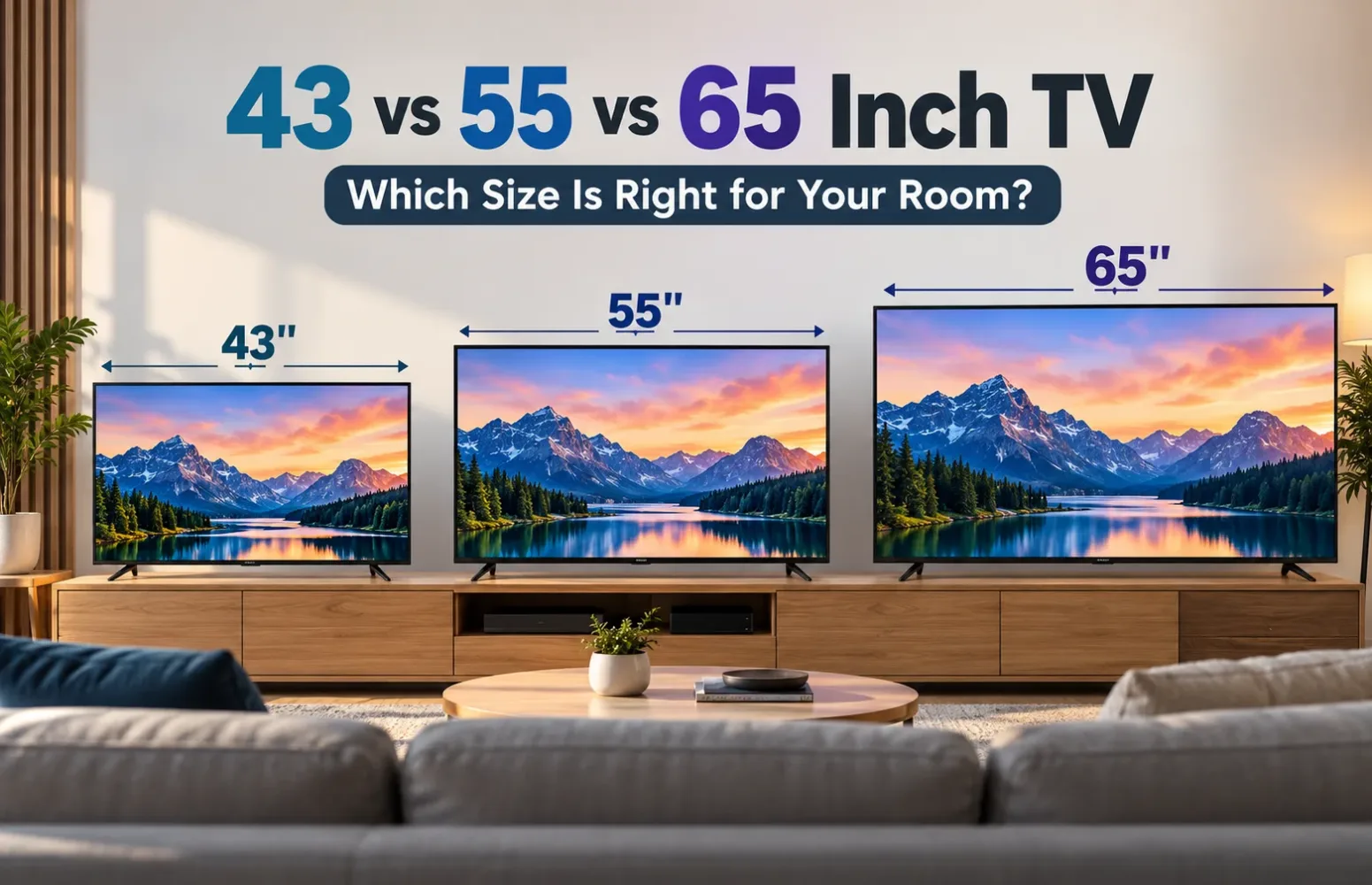
A 55-inch television can look enormous in a showroom and surprisingly ordinary once you put it on your living room wall. A 65-inch model might seem excessive until you sit three metres away and realise how much smaller the picture appears from your sofa.
That is why I would never choose a television based on screen size alone.
Your ideal TV size depends on how far you sit from the screen, what you usually watch, and how much space you have in your room.
There is also a bigger difference between these three sizes than their numbers suggest. A 65-inch TV gives you nearly 40% more viewing area than a 55-inch model. Moving from 43 to 55 inches brings an even bigger increase of approximately 64%.
So, which should you buy?
For most compact bedrooms, 43 inches can be sufficient. A 55-inch TV is a sensible choice for many medium-sized living rooms. At longer seating distances, especially for films, sports and gaming, 65 inches starts becoming much more appealing.
But those are starting points, not fixed rules.
43 vs 55 vs 65 Inch TV: Quick Comparison
| TV size | Suggested viewing distance | Best suited for |
|---|---|---|
| 43 inches | 1.3–1.8 metres (4.3–5.8 ft) | Bedrooms, compact rooms and close seating |
| 55 inches | 1.7–2.3 metres (5.5–7.5 ft) | Medium living rooms and mixed entertainment |
| 65 inches | 2.0–2.7 metres (6.5–8.8 ft) | Larger seating areas, films, sports and console gaming |
These approximate ranges correspond to a 40° cinematic viewing angle at the closer end and a 30° mixed-use angle at the farther end. They are flexible guidelines, not medical or ergonomic limits.
My preference would be to start by measuring the actual seating distance rather than choosing a television based on whether the room is described as small, medium or large.
A relatively small living room can accommodate a 65-inch television if the seating arrangement supports it. Conversely, a large room with a sofa positioned close to the screen may not need one.
How Much Bigger Are 43, 55 and 65 Inch TVs?
TV sizes are measured diagonally from one corner of the screen to the opposite corner, rather than across its width.
This distinction matters when you are trying to decide whether a TV will fit inside a wall unit or above an entertainment cabinet.
For conventional 16:9 widescreen televisions, the approximate visible screen dimensions are:
| Screen size | Width | Height |
|---|---|---|
| 43 inches | 95.2 cm | 53.5 cm |
| 55 inches | 121.8 cm | 68.5 cm |
| 65 inches | 143.9 cm | 80.9 cm |
These measurements exclude the bezel, stand and other parts of the television’s frame. The manufacturer’s actual dimensions should always be checked before purchase.
One particularly interesting comparison is between 55 and 65 inches.
The larger television adds approximately 22 cm of visible width and 12 cm of height, but its total screen area increases by nearly 40%.
That extra picture area can make films feel more engaging, improve the visibility of distant sports action and make interface elements easier to read from a longer distance.
The difference is even more substantial when moving from 43 to 65 inches. The 65-inch screen has roughly 128% more visible area.
If you want to understand the difference visually before buying, iTechVora’s Screen Size Comparison tool lets you compare the physical dimensions and area of different displays.
What Is the Ideal Viewing Distance for Each TV Size?
Viewing distance deserves more attention than most television specifications.
A screen needs to occupy enough of your field of vision for you to appreciate details comfortably, but not so much that watching everyday content becomes tiring or inconvenient.
One useful approach is to consider two viewing preferences:
- Around 30°: A balanced field of view for television programmes, sports, news and general entertainment.
- Around 40°: A wider field of view that some viewers prefer for cinematic films and story-driven games.
Using these viewing-angle benchmarks, the approximate distances are:
| TV size | General viewing (30°) | Cinema-oriented viewing (40°) |
|---|---|---|
| 43 inches | 1.78 m / 5.8 ft | 1.31 m / 4.3 ft |
| 55 inches | 2.27 m / 7.5 ft | 1.67 m / 5.5 ft |
| 65 inches | 2.69 m / 8.8 ft | 1.98 m / 6.5 ft |
These figures are based on screen geometry and established viewing-angle guidance. They do not mean that sitting outside these distances is automatically uncomfortable or unsafe.
For example, if your sofa is approximately 2.4 metres from the screen, both 55-inch and 65-inch televisions remain reasonable options. The 55-inch model will feel more restrained, while the 65-inch version will occupy more of your vision.
I would lean towards 65 inches in that situation if films, high-quality streaming and gaming are major priorities.
You can enter your actual sofa distance into iTechVora’s TV Size and Viewing Distance Calculator to explore different viewing preferences rather than relying on a single recommendation.
When Does a 43-Inch TV Make Sense?
A 43-inch TV remains a practical option for rooms where viewers sit relatively close.
Consider a bedroom with the television mounted opposite the bed. If the viewing distance is around 1.5 metres, a 43-inch model can provide a satisfying picture without occupying most of the wall.
It is also worth considering for smaller apartments, secondary TVs or rooms where entertainment is not the main activity.
I would look at 43 inches when:
- The normal viewing distance is around 1.3–1.8 metres.
- There is limited room for a large stand or wall installation.
- The television is mainly used for news, YouTube and everyday programmes.
- Keeping the purchase cost down matters more than maximizing screen size.
However, I would be cautious about choosing 43 inches for a main living room where the sofa is more than 2.5 metres away.
At that distance, smaller subtitles, cricket scores and other on-screen text may become less comfortable to read, especially for people with reduced visual acuity.
One more consideration: smaller variants within a television series do not always include the same panel, refresh-rate or gaming features as their larger counterparts. Before buying, compare the specifications of both sizes carefully, as the 43-inch model may have different features or display capabilities from its 55-inch counterpart.
Why 55 Inches Is a Sensible Middle Ground
If I were choosing one screen size for a household with mixed viewing habits, 55 inches would be high on my shortlist.
It gives you substantially more display area than 43 inches without requiring the space of a 65-inch set.
For a sofa approximately two metres away, a 55-inch television can work well for evening films, streaming shows, sports and gaming.
This makes it worth considering in Indian homes where the same living room serves several purposes throughout the day.
A 55-inch television is particularly appealing when the household watches a mixture of:
- HD television channels and DTH broadcasts.
- Netflix, Prime Video, YouTube and other streaming services.
- Sports and family entertainment.
- PlayStation, Xbox or casual games.
But there is a catch.
At a distance approaching three metres, a 55-inch TV may begin to look relatively small if you want a more engaging film-watching experience.
The TV itself has not become worse. The seating distance simply reduces how much of your vision the picture occupies.
This is the point where I would start seriously comparing a 65-inch alternative.
Is a 65-Inch TV Really Too Large for Your Living Room?
Not necessarily.
The idea that a 65-inch television requires an enormous living room is increasingly outdated, especially when you are buying a modern 4K set.
If your sofa is approximately 2.5 metres away, a 65-inch TV produces a field of view a little wider than 30 degrees. That is well within the range commonly discussed for everyday viewing.
For films and story-driven games, the larger picture can be particularly enjoyable.
A 65-inch screen can also be a practical choice for families who watch together, especially when some seats are positioned farther from the television. The extra size helps visibility, although it does not solve poor viewing angles caused by the panel itself.
I would seriously consider 65 inches when:
- The viewing distance is around 2–2.7 metres, or even farther if the buyer prefers a larger picture.
- Films, cricket, football or console games are frequent activities.
- The wall and furniture can accommodate the television safely.
- The available budget still allows for a good-quality display.
There are trade-offs, though. Larger televisions generally cost more within the same product series, require additional installation space and may consume more power under comparable usage conditions.
If your seating distance is barely 1.5 metres and you mainly watch television news or standard HD broadcasts, a 65-inch set may be unnecessarily large for your preferences.
Does 4K Resolution Change Which Size You Should Buy?
Yes, but perhaps not in the way buyers expect.
If you compare three televisions with the same native 4K UHD resolution of 3840 × 2160, all three have approximately 8.3 million pixels.
The 65-inch model spreads those pixels across a larger physical surface, meaning its pixel density is lower than that of a 43-inch model.
That does not automatically mean the smaller TV looks better.
What matters is how far you sit from the screen and the quality of the content being displayed.
At an appropriate distance, a good 65-inch 4K television can show plenty of fine detail without individual pixels becoming distracting.
The problem becomes more complicated with poor-quality video.
Highly compressed streaming, lower-resolution broadcasts and older content can reveal imperfections more prominently when enlarged. How well the television processes and upscales those sources matters considerably.
If much of your viewing comes from ordinary HD DTH channels, I would pay close attention to the TV’s video processing rather than choosing the largest model automatically.
For a closer explanation of resolution and pixel density, iTechVora also has a Display Pixel Density Calculator.
Premium 55-Inch vs Budget 65-Inch TV: Which Is the Smarter Buy?
This is where the buying decision becomes genuinely interesting.
Suppose your budget allows either a higher-end 55-inch Mini-LED television or a basic 65-inch LED LCD television.
The larger model gives you more picture area. The smaller premium model may offer better contrast control, brightness, motion handling or gaming capabilities.
Those improvements are not guaranteed simply because it costs more. They depend on the actual televisions being compared.
For bright-room sports, reflection handling, useful brightness and motion processing deserve attention. For evening films, local dimming and black-level performance can make a noticeable difference. Gamers should examine the native refresh rate, input lag, VRR support and actual HDMI capabilities.
My buying rule would be simple: first establish a suitable screen-size range for your room, then compare picture quality within that range.
I would not sacrifice major picture-quality improvements solely to gain ten inches of diagonal size. On the other hand, spending more on a smaller premium television may not be worthwhile if a well-equipped 65-inch model better suits your room and viewing habits.
Our OLED vs QLED vs Mini-LED comparison explains why display technology and backlight performance can matter as much as screen size.
43 vs 55 vs 65 Inch TV: Which Size Makes More Sense for Gaming?
A larger screen can make story-driven adventures, racing games and open-world environments more engaging, particularly from the sofa.
At around two metres, I think both 55-inch and 65-inch televisions deserve consideration. The larger option suits players who enjoy a broad, cinematic view, while the smaller one may feel more comfortable for certain fast-paced games or closer seating arrangements.
However, screen size does not determine gaming performance.
A 43-inch television with genuine 4K 120Hz support, VRR and low input lag could be a better gaming display than a basic 65-inch TV with a 60Hz panel and limited gaming capabilities.
For PS5 owners, I would examine the television’s supported 4K 120Hz modes, HDMI inputs, VRR compatibility and Game Mode performance.
Choose the display size for comfort and visibility, but choose the television model for the gaming features you actually need.
Three Things to Check Before Ordering Your TV
1. Measure the distance from your eyes, not just the room length
A room that is three metres long does not automatically give you three metres of viewing distance. The depth of the sofa, the mounting position and the furniture arrangement all reduce the actual distance.
Sit where you normally watch television and measure from your eyes to the screen’s intended position.
2. Check the television’s full dimensions
A 65-inch screen is approximately 144 cm wide, but the complete television may have additional width because of its frame.
Check the manufacturer’s exact measurements, stand-foot spacing, wall-mount specifications and weight.
You should also leave enough space for ventilation, cabling and safe installation.
3. Test the size visually before purchasing
Mark the approximate width and height of your preferred size on the wall using removable masking tape.
Do this for both 55 and 65 inches, then sit on your normal sofa.
You may discover that the larger model fits more naturally than expected—or that it overwhelms the available wall space.
This simple exercise can help prevent an expensive purchasing mistake.
Frequently Asked Questions
Is a 65-inch TV too big for a 10 × 12 foot room?
Not automatically. The important measurement is the distance from the viewer’s eyes to the screen, not just the room’s floor dimensions. Depending on furniture placement, a 65-inch TV could work well, but a 55-inch model might be more practical in a closer seating arrangement.
Is a 55-inch TV good for a 10-foot viewing distance?
It can be used at that distance, but it produces a relatively narrow field of view. A 65-inch or even larger screen may be more appealing for films and gaming, depending on the available space and budget.
Can I sit seven feet away from a 65-inch 4K TV?
Yes. At approximately 2.13 metres, a 65-inch screen creates a fairly wide field of view that can suit cinematic viewing. Whether it feels comfortable depends on your preferences, eyesight and content.
Does a bigger TV always use more electricity?
Larger screens often require more power within comparable television ranges, but panel technology, brightness settings, picture content and efficiency also influence consumption. Compare the official India-specific energy labels and product specifications instead of assuming that diagonal size alone determines electricity costs.
Final Verdict: 43, 55 or 65 Inches?
After comparing the physical dimensions, viewing distances and practical compromises, I think the decision becomes much easier when you stop treating screen size as a competition.
Choose 43 inches for close viewing, bedrooms, compact layouts or secondary televisions where space and budget are the priority.
Choose 55 inches for a versatile main television when the sofa is roughly 1.7–2.3 metres away and your household watches a mixture of streaming, sports, ordinary channels and games.
Choose 65 inches when the seating distance is around two metres or more, the budget allows it, and you want movies, sports or games to occupy more of your vision.
For a typical mixed-use living room, 55 inches is a sensible starting point. But once the sofa moves beyond roughly 2.4 metres, I would strongly consider 65 inches before placing an order.
Ultimately, the better television is not simply the largest one. It is the one that fits your seating arrangement, performs well with your content and leaves you satisfied with both its picture quality and its price.
Trusted Sources
- RTINGS — TV Size to Distance Calculator and Viewing-Angle Guidance (Updated June 3, 2026)
https://www.rtings.com/tv/reviews/by-size/size-to-distance-relationship - Sony India — Recommended Television Viewing Distances
https://www.sony.co.in/electronics/support/articles/00008601 - iTechVora — Screen Size Comparison Tool and Calculation Methodology
https://itechvora.com/tools/screen-size-comparison/ - iTechVora — TV Size and Viewing Distance Calculator
https://itechvora.com/tools/tv-viewing-distance-calculator/ - iTechVora — OLED vs QLED vs Mini-LED Display Technology Guide
https://itechvora.com/tvs/oled-vs-qled-vs-mini-led/
Report an issue with this article
Spotted outdated information or a broken link? The article URL is included automatically. Reports are private. Please do not include sensitive personal information.
Contact us at itechvora@gmail.com with the article link.