
I think the most confusing part of buying a TV today is that OLED, QLED and Mini-LED sound like three directly competing display technologies.
They are not.
OLED is fundamentally different because its pixels produce their own light. QLED is usually an LCD TV that uses quantum dots to improve color, while Mini-LED describes a more advanced backlight system used behind an LCD panel. In fact, a Mini-LED TV can also be a QLED TV at the same time. Samsung’s current Neo QLED models are a good example: they combine quantum-dot technology with Mini-LED backlighting.
That distinction matters more than the logos on the box.
For dark-room films, OLED’s pixel-level light control remains extremely attractive. For bright rooms, sports and large bright scenes, a good Mini-LED TV can make more sense. Standard QLED covers a much wider range, from relatively affordable TVs to premium models, so the QLED badge alone tells me surprisingly little about final picture quality.
OLED vs QLED vs Mini-LED at a glance
| Technology | How it creates the picture | Main strength | Main trade-off |
|---|---|---|---|
| OLED | Each pixel emits its own light | Black levels, contrast, viewing angles, fast pixel response | Burn-in consideration and brightness behavior with large bright scenes |
| QLED | LCD + LED backlight + quantum dots | Strong color and potentially high brightness | Quality depends heavily on backlight and local dimming |
| Mini-LED | LCD with much smaller LEDs behind the panel | High brightness with more precise local dimming | Can still show blooming because lighting is controlled in zones |
The easiest way I would think about this is:
OLED controls light pixel by pixel. Mini-LED controls groups of pixels with increasingly small lighting zones. QLED primarily describes how quantum dots help create color in an LCD-based TV.
What is OLED?
OLED stands for Organic Light-Emitting Diode.
Unlike an LCD television, an OLED panel does not require a separate backlight. Each pixel can generate and control its own light. LG Display describes OLED as self-emissive, with individual pixels able to switch themselves on and off independently.
That gives OLED one fundamental advantage.
When a pixel needs to display black, it can effectively turn off.
There is no bright backlight sitting behind that black area trying to shine through an LCD layer.
Why OLED black levels look different
Imagine a night sky containing a tiny bright star.
An OLED can illuminate the pixels forming the star while leaving the surrounding pixels dark.
An LCD TV instead has to illuminate an area behind those pixels. Good local dimming can make that area very small, but it is still an area rather than an individual pixel.
That is why OLED avoids the haloing or blooming that can appear around bright subtitles, stars or lamps against black backgrounds.
Current independent testing continues to find OLED particularly strong for dark-room contrast and wide viewing angles.
OLED is not just one technology anymore
There are also different OLED implementations.
Two important ones are:
- WOLED
- QD-OLED
QD-OLED is especially easy to confuse with QLED.
They are not the same thing.
A QD-OLED remains a self-emissive OLED display but uses quantum dots as part of its color-generation system. A conventional QLED TV remains LCD-based and relies on a backlight.
What is QLED?
QLED generally refers to an LCD television that uses a quantum-dot layer.
Quantum dots are nanoscale materials that can convert light into particular wavelengths of color. Samsung describes its QLED architecture as using quantum-dot material together with a light source to generate color.
But this is the part I would pay attention to:
QLED does not automatically tell you how sophisticated the TV’s backlight is.
A QLED television might use a relatively simple LED backlight.
Another QLED might have full-array local dimming.
Another could use hundreds or thousands of Mini LEDs.
Those televisions can therefore behave very differently even though all of them carry a QLED label.
What quantum dots are actually good at
The practical purpose is primarily color and light efficiency.
That can help QLED televisions maintain strong color at high brightness levels, which is particularly useful for HDR and brighter environments.
But I would never buy a television solely because “QLED” appears on the specification sheet.
I would still check:
- backlight type
- local dimming
- brightness
- panel characteristics
- reflection handling
- HDR performance
- viewing angles
- processing
Those details tell you considerably more.
What is Mini-LED?
Mini-LED is not another type of LCD pixel.
It is a backlight technology.
Traditional LCD televisions illuminate their panels using LEDs positioned behind or around the display. Mini-LED TVs use much smaller LEDs, allowing manufacturers to fit more light sources behind the panel and divide them into more precisely controlled local-dimming areas.
Samsung describes Mini-LED as using smaller LEDs for more precise local dimming, while TCL describes its systems as using many LEDs and independently controlled areas to improve light control.
This is why many premium LCD televisions now use Mini-LED.
Why Mini-LED matters
More precise backlighting can help an LCD television produce:
- deeper-looking blacks
- brighter HDR highlights
- better contrast
- less obvious blooming
- stronger performance in bright rooms
But there is an important qualification.
More dimming zones do not automatically equal better picture quality.
The TV’s processing and dimming algorithm decide when those zones brighten, darken and transition.
I would rather have intelligently controlled zones than an enormous zone-count number attached to poor software.
OLED still has the cleaner black-level advantage
This is where the architectural difference matters most.
Even sophisticated Mini-LED TVs control lighting in zones.
OLED controls it at pixel level.
Independent comparisons still show OLED avoiding the haloing that can remain visible around small bright objects on Mini-LED LCD televisions.
So for someone who watches a lot of:
- films in a dark room
- space scenes
- dark prestige TV dramas
- movies with letterbox bars
- subtitle-heavy content
I would pay very close attention to OLED.
The difference becomes less obvious once ambient light enters the room, though.
Brightness is no longer an easy OLED-vs-Mini-LED answer
A few years ago I would have described this much more simply:
LCD gets brighter, OLED gets darker blacks.
That is now too crude.
Recent OLED generations have improved substantially, while premium Mini-LED models continue pushing brightness upward.
RTINGS’ March 2026 comparison found that brightness now varies enough by model that panel type alone is not a reliable way to determine which specific TV will be brighter. It also found that LCD/QLED models generally retain an advantage with very bright, large-screen content, while modern OLEDs can be extremely bright with smaller HDR highlights.
That distinction matters.
A tiny HDR reflection and an entire snowy landscape place very different demands on a television.
So when manufacturers advertise enormous peak-brightness figures, I would want to know how that number was measured before drawing any conclusions.
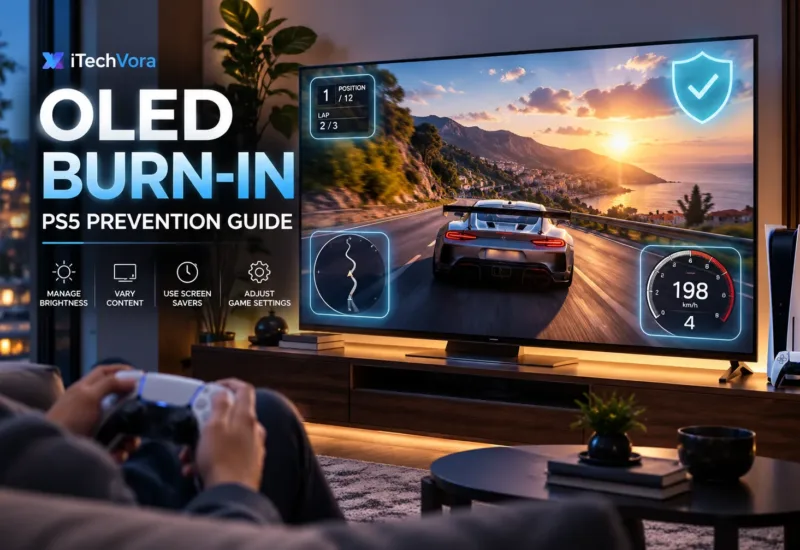
What about OLED burn-in?
This deserves a balanced answer rather than either panic or dismissal.
OLED pixels are organic light-emitting components, so uneven long-term wear can potentially create permanent image retention when the same static elements remain on screen extensively.
RTINGS’ long-term testing has demonstrated OLED burn-in under sustained static-content conditions. At the same time, it notes that users watching varied content may go years without encountering it.
The users I would think about most carefully are people running:
- news channels with persistent graphics for many hours
- fixed information dashboards
- signage
- the same game with static HUD elements for extremely long periods
- a TV as a desktop monitor with persistent windows
For normal mixed film, TV, streaming and gaming use, I would view burn-in as a consideration, not an automatic reason to avoid OLED.
Mini-LED LCD does not have the same OLED burn-in mechanism, although LCD televisions can develop other aging or uniformity issues over time.
Which is better for a bright room?
This is one area where I would look closely at Mini-LED.
A strong Mini-LED television can sustain substantial brightness across larger portions of the screen, which is valuable for:
- daytime sports
- rooms with large windows
- brightly lit family rooms
- HDR content
- large-screen viewing
But brightness alone is not enough.
Reflection handling can matter just as much.
A 2,000-nit television with poor reflections may be less comfortable in a sunny room than a somewhat dimmer television with an excellent anti-reflection treatment.
So I would check the individual model rather than assuming Mini-LED = automatically better bright-room TV.
Which is better for gaming?
Both can be excellent.
OLED’s very fast pixel response is particularly attractive for fast motion, and the absence of local-dimming zones means you do not get blooming around bright HUD elements against a dark background.
Mini-LED can counter with higher sustained brightness in some games and no OLED burn-in mechanism.
But the display technology is only one part of gaming performance.
I would check:
- 4K 120Hz support
- 144Hz support for PC use
- VRR
- ALLM
- HDMI 2.1 port configuration
- input lag
- HDR performance in Game Mode
- FreeSync or G-SYNC compatibility
- eARC port sharing
A mediocre gaming implementation does not become excellent simply because the panel says OLED or Mini-LED.
So which technology should you choose?
This is how I would approach the decision.
Choose OLED when:
You care most about dark-room movies, truly dark blacks, precise contrast, wide seating positions and fast pixel response.
OLED also makes a particularly convincing choice for a mixed movie-and-gaming setup.
Choose Mini-LED when:
You have a bright room, watch a lot of daytime sports or television, want powerful HDR brightness, or regularly display static content and would rather avoid OLED’s burn-in consideration.
Premium Mini-LED TVs can now get remarkably close to OLED in some scenes, although small bright objects against black backgrounds can still expose the limitations of zone-based lighting.
Choose standard QLED when:
You want strong color and good brightness but do not necessarily need premium OLED or Mini-LED pricing.
Just remember that QLED spans an enormous quality range.
I would investigate the actual backlight and local-dimming system before deciding whether a particular QLED is good value.
OLED vs QLED vs Mini-LED: my final view
What surprised me most about this comparison is that Mini-LED and QLED should not really be treated as mutually exclusive technologies.
That changes how I would shop.
Rather than asking:
OLED, QLED or Mini-LED?
I would ask:
Is this OLED, or is it an LCD? If it is LCD, does it use quantum dots, what kind of backlight does it use, and how well does its local dimming work?
That gets much closer to what actually determines picture quality.
For a dark home-theater environment, OLED’s pixel-level control remains extremely difficult for an LCD to replicate.
For a bright multipurpose room, a strong Mini-LED QLED can make considerably more sense.
And for a more budget-conscious purchase, regular QLED can still be perfectly sensible—provided you judge the actual television rather than the badge.
The technology gives you the starting point.
The individual TV model still decides the result.
FAQs
Is Mini-LED better than QLED?
They are not directly competing concepts. Mini-LED describes the backlight, while QLED usually describes the use of quantum dots in an LCD television. A TV can be both Mini-LED and QLED.
Is OLED better than Mini-LED?
OLED provides pixel-level light control, giving it an inherent advantage in black levels and eliminating local-dimming halos. Mini-LED can offer advantages such as high sustained brightness and no OLED burn-in mechanism. Which matters more depends on how and where you watch TV.
Does Mini-LED have perfect blacks?
Not in the same way as OLED. Mini-LED can produce very deep blacks using local dimming, but several pixels typically share one lighting zone, so blooming can still occur.
Does QLED mean Mini-LED?
No. Some QLED TVs use Mini-LED backlighting, while others use more conventional LED backlights.
Is OLED good for gaming?
Yes, provided the individual TV offers the required gaming features. Fast pixel response is an OLED strength, but HDMI 2.1, VRR, refresh rate and input lag should still be checked separately.
Can OLED TVs suffer burn-in?
Permanent burn-in is possible under prolonged static-content conditions. The practical risk varies considerably with usage pattern and should not be treated as inevitable for normal mixed viewing.
Report an issue with this article
Spotted outdated information or a broken link? The article URL is included automatically. Reports are private. Please do not include sensitive personal information.
Contact us at itechvora@gmail.com with the article link.