
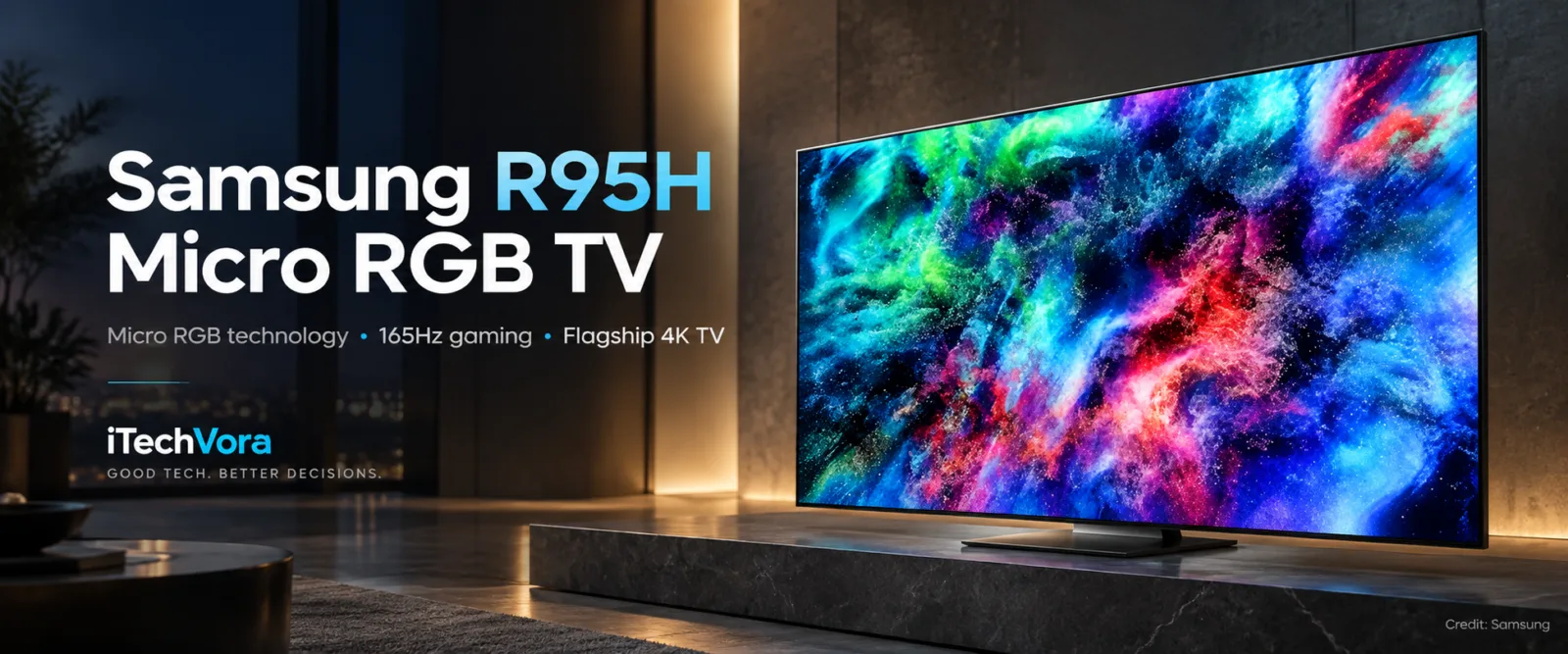
Samsung’s R95H is interesting for a reason that has little to do with AI labels or smart-TV features. Its biggest change happens behind the LCD panel.
Instead of relying on a conventional blue-led Mini LED backlight paired with quantum dots, the R95H uses Samsung’s Micro RGB system with separate microscopic red, green and blue light sources. The goal is broader, more precisely controlled color while retaining the brightness advantages associated with premium LCD televisions.
That makes the R95H one of Samsung’s most technically ambitious TVs of 2026. It also places it in an unusual position: this is still an LCD television rather than a self-emissive MicroLED or OLED display, but Samsung is trying to close some of the color and contrast gap through a much more sophisticated backlight.
The mainstream R95H range is available in 65-, 75- and 85-inch sizes, with the Micro RGB AI Engine Pro, 4K resolution, 165Hz variable refresh support, Samsung’s Glare Free screen treatment and the company’s latest Tizen platform.
Samsung R95H at a Glance
| Detail | Samsung R95H |
|---|---|
| Display type | LCD with Micro RGB backlighting |
| Resolution | 3840 × 2160 |
| Main sizes | 65, 75 and 85 inches |
| Picture processor | Micro RGB AI Engine Pro |
| Maximum refresh rate | Up to 165Hz with VRR |
| HDR | HDR10+, Micro RGB HDR Pro |
| Anti-reflection | Samsung Glare Free |
| Color technology | Micro RGB Precision Color 100 |
| Gaming connectivity | Four HDMI 2.1 ports according to independent testing |
| Smart platform | One UI Tizen |
| Audio | Dolby Atmos, OTS+, Q-Symphony |
| US launch pricing | $3,199.99 / $4,499.99 / $6,499.99 for 65 / 75 / 85 inches |
| Dolby Vision | No |
Samsung’s official US launch pricing places the R95H firmly in flagship territory. The 65-inch model started at $3,199.99, followed by $4,499.99 for 75 inches and $6,499.99 for 85 inches. Retail promotions can change those numbers substantially, so the current selling price should be checked separately from MSRP.
What Makes Micro RGB Different?
The name can be confusing because Micro RGB is not the same technology as a self-emissive MicroLED television.
The R95H remains an LCD TV. What changes is its backlight. Samsung uses microscopic red, green and blue LEDs rather than generating the backlight primarily from blue LEDs and then relying on additional color-conversion layers.
This gives the backlight more direct control over individual color components.
Samsung says the R95H’s Micro RGB system can cover 100% of the BT.2020 color area, with the company’s Micro RGB Precision Color certification verified by VDE. BT.2020 represents a much wider color space than the color gamut used by most current consumer video content, so the practical significance is not simply that every movie suddenly uses more colors. The technology instead gives the television additional headroom when reproducing demanding HDR colors.
Independent measurements provide useful context here. RTINGS found excellent color purity and unusually strong color volume from the R95H’s new RGB backlighting architecture. Its testing also identified a limitation: highly saturated colors can interact with nearby white elements, causing whites to temporarily pick up some of the surrounding tint in certain situations.
That is an important reminder that Micro RGB is not automatically superior in every picture-quality characteristic simply because it is newer.
The R95H Is Samsung’s Higher-End Micro RGB Model
Samsung has two primary Micro RGB families in its 2026 lineup: R95H and R85H.
The differences are more substantial than their similar names suggest.
| Feature | R95H | R85H |
|---|---|---|
| Processor | Micro RGB AI Engine Pro | Micro RGB AI Engine |
| HDR system | Micro RGB HDR Pro | Micro RGB HDR+ |
| Gaming motion | Up to 165Hz | Up to 144Hz |
| Object Tracking Sound | OTS+ | OTS Lite |
| Design | Infinity Air Design | Monolith Edge Design |
| Wireless One Connect | Ready | No |
| Main sizes | 65, 75, 85 inches | 55, 65, 75, 85, 100 inches |
Samsung therefore positions the R95H as the performance-focused model, while the R85H offers Micro RGB technology across a broader selection of sizes and at lower starting prices.
For example, Samsung launched the US 65-inch R85H at $2,099.99, compared with $3,199.99 for the equivalent-size R95H. That $1,100 difference makes the comparison particularly important for buyers who mainly want Micro RGB color rather than every flagship feature.
Gaming Is One of the R95H’s Strongest Use Cases
The R95H supports Motion Xcelerator 165Hz with VRR, which immediately makes it more interesting to high-end PC gamers than a television limited to 120Hz.
A PlayStation 5 or Xbox Series X user will not receive the same benefit from the full 165Hz ceiling because current consoles normally target up to 120Hz output. For PC gaming, however, the additional refresh-rate headroom becomes more meaningful when paired with sufficiently powerful hardware.
RTINGS reports that the television has four HDMI 2.1 inputs capable of handling up to 4K at 165Hz and supports the major VRR formats. The same testing also found support for 1080p at refresh rates up to 240Hz.
Samsung also provides HDR10+ Gaming, Game Bar features and its gaming-oriented Tizen functionality.
The significant omission remains Dolby Vision. Samsung continues to support HDR10 and HDR10+ rather than Dolby Vision, so buyers with a large Dolby Vision library should keep that ecosystem difference in mind. Independent testing also confirms that the R95H does not support Dolby Vision.
Bright Rooms Could Be Where the R95H Makes the Most Sense
OLED remains difficult to beat when absolute black levels and pixel-level control are the priority, but premium LCD televisions have another advantage: they can be extremely effective in rooms where ambient light is difficult to control.
Samsung combines the R95H’s powerful backlight with its Glare Free screen treatment.
Independent testing from both RTINGS and TechRadar found the television particularly capable in brighter environments, with high brightness and strong reflection handling helping the image remain visible when room lighting would be more troublesome for some displays.
That could make the R95H particularly relevant for living rooms with large windows, daytime sports viewing or installations where blackout curtains are unrealistic.
The trade-off is that an LCD still relies on local dimming rather than individual self-emissive pixels. TechRadar observed some blooming during its testing, one of the areas where premium OLED displays can still maintain an advantage.
Audio Is Better Equipped Than a Typical Thin TV
Samsung specifies a 4.2.2-channel, 70W speaker system on the R95H, together with Dolby Atmos, Object Tracking Sound+, Adaptive Sound Pro and Q-Symphony support.
Q-Symphony allows compatible Samsung soundbars to operate alongside the television’s speakers rather than simply replacing them.
The built-in hardware is substantial by modern television standards, but anyone building a dedicated home-theater setup should still consider a separate sound system. Independent testing similarly found the integrated audio usable but limited in the bass and overall scale expected from cinematic content.
One UI Tizen and Seven Years of Updates
The R95H runs Samsung’s One UI Tizen smart-TV platform.
Samsung says its 2026 televisions will receive up to seven years of Tizen OS upgrades, potentially giving the R95H a much longer software lifespan than buyers traditionally expected from a television.
The platform also ties together Samsung TV Plus, Gaming Hub and the company’s 2026 Vision AI features.
Those AI functions should not be the primary reason to choose the R95H, but some are more practical than the branding suggests. Samsung’s processing system handles functions including 4K upscaling, HDR remastering, picture optimization and scene-based audio processing.
As with any AI-enhanced picture mode, viewers who prefer a more reference-oriented movie presentation may still want to experiment with Filmmaker Mode and picture settings rather than leaving every enhancement enabled.
What About the 130-Inch Samsung R95H?
There is an important naming complication.
Samsung unveiled a 130-inch Micro RGB R95H at CES 2026, describing it as its largest Micro RGB display and showcasing a dramatic new frame-style design.
That model should not simply be treated as a giant version of the 65-, 75- and 85-inch retail R95H when comparing specifications, pricing or availability.
Samsung’s regular R95H consumer listings currently center on the 65-, 75- and 85-inch versions, while its 2026 lineup also includes other very large Micro RGB products and the carry-over 115-inch R95F in some markets.
Buyers should therefore verify the exact model code rather than relying only on the “Micro RGB” or “R95H” branding.
Who Is the Samsung R95H For?
The R95H makes the most sense for someone specifically shopping at the premium end of the TV market and who wants LCD strengths without settling for conventional Mini LED technology.
Its most compelling combination is wide color capability, high brightness, effective reflection control and unusually strong gaming specifications.
OLED remains a serious alternative for viewers who prioritize pixel-level black control, dark-room movie performance or Dolby Vision. Meanwhile, Samsung’s cheaper R85H deserves consideration when 144Hz is sufficient and the R95H’s higher-end processor and additional features do not justify the price difference.
For bright-room viewing and high-refresh PC gaming, however, the R95H offers a combination that is much harder to dismiss.
Key Takeaways
- The Samsung R95H is a 4K LCD TV using Micro RGB backlighting, not a self-emissive MicroLED television.
- Main retail sizes are 65, 75 and 85 inches, with up to 165Hz VRR and Samsung’s Glare Free treatment.
- Samsung positions it above the R85H with a stronger processor, higher gaming refresh rate and upgraded audio/design features.
- Independent testing supports the R95H’s strong color and bright-room performance, while also revealing some color-interaction and blooming limitations.
- Dolby Vision remains unsupported.
- Its premium price means buyers should compare it directly with Samsung’s own R85H as well as high-end OLED alternatives.
Price and Availability
Samsung launched the R95H during 2026, although exact configurations, promotions and availability differ by region.
In the United States, official launch prices were $3,199.99 for 65 inches, $4,499.99 for 75 inches and $6,499.99 for 85 inches. Samsung has subsequently offered promotional pricing on some models, so those figures should be treated as launch/MSRP references rather than guaranteed current prices.
Samsung also lists the R95H in markets including India, the UK and Australia, but model codes, stock status, promotions and pricing differ. Buyers should use the Samsung store for their own country rather than converting US pricing directly.
Trusted Sources Used
| Source | Used for |
|---|---|
| Samsung R95H 65-inch official product page | Official specifications, size options and US pricing |
| Samsung 2026 Micro RGB lineup announcement | R95H/R85H lineup, pricing, BT.2020 claims and software information |
| Samsung Micro RGB TV comparison | R95H vs R85H specifications |
| Samsung 130-inch R95H CES announcement | 130-inch R95H clarification |
| RTINGS Samsung R95H testing | Independent panel, gaming, color and format testing |
| TechRadar Samsung R95H review | Independent bright-room, contrast, motion, gaming and audio observations |
Research status: Information checked against currently available sources on September 25, 2026. Retail prices and promotions can change after publication.
Samsung 65-Inch Class Micro RGB R95H 4K Samsung Vision AI Smart TV (2026) — MRN65R95HAFXZA (US)
A premium 65-inch LCD aimed particularly at bright-room viewing and high-refresh gaming, combining Samsung’s Micro RGB backlight, Glare Free screen and up to 4K/165Hz VRR support. The biggest considerations are its flagship-level price and lack of Dolby Vision.
How we tested
Research-based assessment; no iTechVora hands-on testing conducted. Specifications and technical information are based on verified manufacturer documentation and clearly attributed independent sources where applicable.
What we like
- Micro RGB backlighting expands color capability beyond Samsung’s conventional LED backlight designs.
- Glare Free screen treatment is standard on the R95H.
- All four HDMI 2.1 ports support signals up to 4K/165Hz, giving gaming PCs considerable refresh-rate headroom.
- VRR, FreeSync Premium Pro and G-SYNC compatibility provide broad variable-refresh support.
- 70W 4.2.2-channel audio system with Dolby Atmos, OTS+ and Q-Symphony.
- Wi-Fi 6E and Bluetooth 5.3 connectivity.
- Independent testing found exceptionally strong reflection handling and high brightness for bright-room use.
What to consider
- Dolby Vision is not supported; Samsung uses HDR10+ instead.
- The current 65-inch price remains firmly in premium-TV territory.
- The full 4K/165Hz capability is primarily relevant to compatible gaming PCs rather than current consoles.
- Samsung’s own regional specification documentation describes the panel as 120Hz native with VRR operation up to 165Hz, while RTINGS categorizes its tested US unit as having a 165Hz native refresh rate. Buyers should therefore treat 165Hz as the verified maximum supported refresh rate rather than assuming all documentation defines the underlying panel identically.
- Independent testing also found that surrounding saturated colors can sometimes influence nearby whites and noted imperfect out-of-box color accuracy.
Key specifications
| Product | Samsung 65-Inch Class Micro RGB R95H 4K Samsung Vision AI Smart TV (2026) |
|---|---|
| Model number | MRN65R95HAFXZA — United States |
| Screen size | 65-inch class |
| Resolution | 3840 × 2160 (4K UHD) |
| Panel technology | LCD; RTINGS identifies the tested 65-inch US model as VA LCD |
| Backlight technology | Micro RGB full-array RGB LED backlighting with local dimming |
| Native refresh rate | Samsung documentation: 120Hz native; VRR up to 165Hz. RTINGS identifies its tested US unit as 165Hz native |
| HDR formats | HDR10, HDR10+, HLG; Dolby Vision not supported |
| Processor | Micro RGB AI Engine Pro |
| Operating system | 2026 Samsung Tizen / One UI Tizen |
| HDMI ports | 4 |
| HDMI 2.1 ports | 4; RTINGS reports full 48Gbps HDMI 2.1 bandwidth on all four |
| Maximum HDMI input | Up to 4K/165Hz on HDMI 1/2/3/4 |
| VRR | Yes |
| ALLM | Yes |
| AMD FreeSync | FreeSync Premium Pro |
| NVIDIA G-SYNC | Compatible/certified according to independent testing |
| ARC/eARC | eARC supported |
| Wi-Fi | Wi-Fi 6E |
| Bluetooth | Bluetooth 5.3 |
| USB ports | 2 × USB-A |
| Ethernet | 1 × LAN |
| Digital audio output | 1 × Optical |
| Audio output | 70W RMS |
| Speaker configuration | 4.2.2-channel |
| Dolby Atmos | Yes |
| Object Tracking Sound | OTS+ |
| Q-Symphony | Yes |
| Anti-reflection | Glare Free |
| Wireless One Connect | Wireless One Connect Ready |
| US tuner | ATSC 3.0 |
| Color technology | Micro RGB Precision Color 100 |
| Screen size & resolution | 65-inch, 3840 × 2160 (4K UHD) |
| Panel technology | LCD with Micro RGB full-array RGB LED backlighting and local dimming; RTINGS identifies the tested 65-inch US variant as a VA LCD panel. |
| Refresh rate | 120Hz native according to Samsung’s detailed 65-inch specification; up to 165Hz with supported VRR/PC input. RTINGS categorizes its tested US unit as 165Hz native, so published descriptions differ on the native-panel terminology while agreeing on a 165Hz maximum 4K input rate. |
| HDMI & connectivity | 4× HDMI with all four supporting up to 4K/165Hz; HDMI 2.1 bandwidth on all four ports; VRR, ALLM, FreeSync Premium Pro, G-SYNC compatibility and eARC supported; 2× USB-A, 1× Ethernet, Wi-Fi 6E, Bluetooth 5.3 and optical digital audio output. |
| Smart TV platform | Samsung Tizen Smart TV / 2026 Tizen platform with One UI Tizen. |
Side-by-side comparison
| Feature | Samsung R95H 65-inch | Samsung S95H OLED 65-inch | Sony BRAVIA 9 II 65-inch |
|---|---|---|---|
| Price | $2,799.99 at Best Buy | $2,799.99 at Best Buy | $3,599.99 at Best Buy |
| Screen size | 65-inch | 65-inch | 65-inch |
| Panel | Micro RGB-backlit LCD / VA | QD-OLED | RGB LED-backlit LCD |
| Resolution | 3840 × 2160 | 3840 × 2160 | 3840 × 2160 |
| Maximum gaming refresh | Up to 165Hz at 4K | Up to 165Hz at 4K | Up to 120Hz at 4K |
| HDR formats | HDR10+, HLG; no Dolby Vision | HDR10+; no Dolby Vision | HDR10, HLG, Dolby Vision |
| HDMI 2.1 | 4 ports, up to 4K/165Hz | 4 ports, up to 4K/165Hz | HDMI 3/4 support 4K120, VRR and related HDMI 2.1 features |
| VRR | Yes | Yes | Yes, HDMI 3/4 |
| Smart TV platform | Samsung Tizen | Samsung Tizen | Google TV / Android TV |
| Gaming features | 4K165, HDMI Forum VRR, FreeSync Premium Pro, G-SYNC compatibility | 4K165, FreeSync Premium Pro, G-SYNC | 4K120, VRR, ALLM, PS5-specific features |
| Audio | 70W, 4.2.2ch, Dolby Atmos, OTS+ | 70W, 4.2.2ch, Dolby Atmos, OTS+ | 80W, eight speaker units, Dolby Atmos |
Our shortlist
| Samsung R95H 65-inch | Relevant for a Best TV for Bright Rooms list because its high brightness and matte Glare Free treatment performed strongly against reflections in independent testing. |
|---|---|
| Samsung R95H 65-inch | Relevant for a Best TV for Gaming list thanks to four HDMI 2.1 ports, 4K/165Hz support and multiple VRR standards. |
| Samsung R95H 65-inch | Relevant for a Best TV for PC Gaming list because compatible PCs can use its 4K/165Hz capability, while RTINGS also verified 1080p input support up to 240Hz. |
| Samsung R95H 65-inch | Relevant for a Best Premium TV list because it combines Samsung’s flagship Micro RGB architecture with its higher-end AI processor, Glare Free treatment and advanced gaming connectivity. |
| Samsung R95H 65-inch | Relevant for a Best 65-inch TV shortlist for buyers specifically prioritizing a premium LCD rather than OLED. |
Step by step
- Update firmware | Open All Settings > Support > Software Update > Update Now; the TV will check for and install an available update.
- Enable Anynet+ for eARC | Open Settings (All Settings) > General > External Device Manager > Anynet+ (HDMI-CEC) and enable it.
- Enable eARC | Open Settings (All Settings) > Sound > Expert Settings > HDMI eARC Mode and set it to Auto.
- Configure digital audio output | Open Settings > All Settings > Sound > Expert Settings > Digital Output Audio Format, then select the format appropriate for the connected sound system.
Your questions, answered
Is the Samsung R95H an OLED TV?
No. It is an LCD television using Samsung’s Micro RGB backlighting system.
Does the Samsung R95H support 120Hz?
Yes. Samsung’s specification material identifies a 120Hz native panel with VRR operation extending up to 165Hz.
Does the Samsung R95H support 165Hz?
Yes. Compatible PC sources can operate at up to 4K/165Hz.
How many HDMI 2.1 ports does the Samsung R95H have?
Four. Independent testing confirms HDMI 2.1 bandwidth on all four ports.
Does the Samsung R95H support VRR?
Yes. HDMI Forum VRR, AMD FreeSync and G-SYNC compatibility are supported according to independent testing.
Does the Samsung R95H support Dolby Vision?
No. Samsung supports HDR10+ on the R95H instead.
Does the Samsung R95H support HDR10+?
Yes, including Samsung-listed Adaptive, Gaming and Advanced implementations.
Does the Samsung R95H support Dolby Atmos?
Yes.
Is the Samsung R95H suitable for PS5 and Xbox Series X?
Its four HDMI 2.1 ports, 4K high-refresh input, VRR and ALLM make it technically well equipped for current-generation consoles, although consoles do not use the TV’s full 165Hz PC capability.
What smart TV platform does the Samsung R95H use?
Samsung’s 2026 Tizen smart-TV platform.
Which Samsung R95H sizes are sold in the US?
65, 75 and 85 inches.
Price & availability
Previous: $3,199.99 $2,799.99
Price last checked on 2026-09-25. Check the retailer for the latest price.
Check Best Buy ↗This retailer link may be an affiliate link. If you buy through it, iTechVora may earn a commission.
Sources & further reading