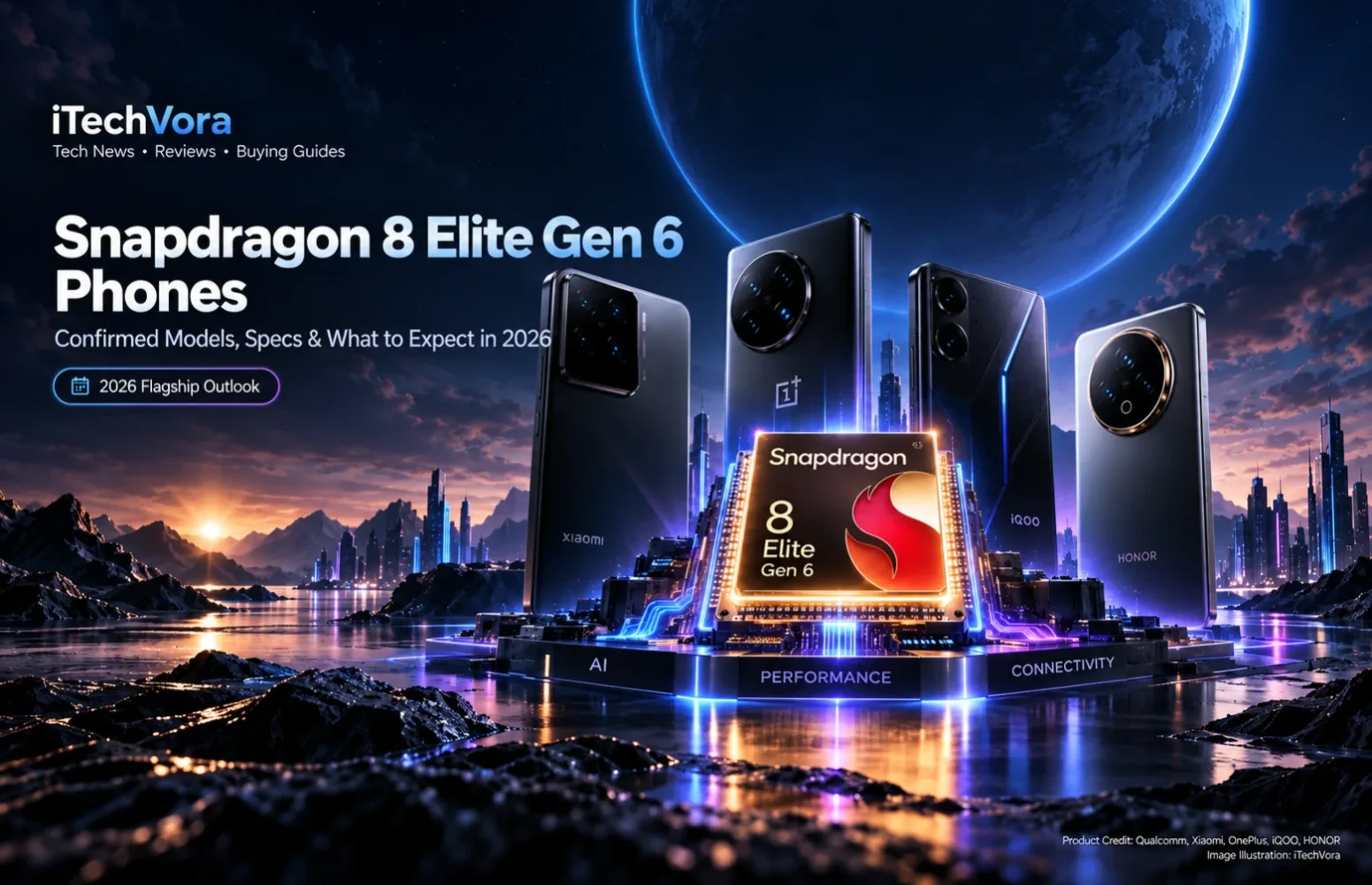
Qualcomm’s next flagship smartphone generation is taking a slightly different shape this year. Instead of introducing one chip for virtually every premium Android flagship, the company has split the top end into two platforms: Snapdragon 8 Elite Gen 6 and the more performance-focused Snapdragon 8 Elite Extreme Gen 6.
Both chips are built on an advanced 2nm process and use Qualcomm’s latest Oryon CPU architecture, but the distinction matters if you are already looking at the next wave of Android phones. Xiaomi has started putting the new silicon into actual devices, while OnePlus, iQOO, HONOR and several other manufacturers are preparing their own Snapdragon Gen 6 flagships.
The first takeaway is simple: seeing “Snapdragon 8 Elite Gen 6 series” attached to a phone does not necessarily mean it uses the same chip as every other model. The standard and Extreme versions are aimed at different levels of the premium market.
Snapdragon 8 Elite Gen 6 phones at a glance
| Phone / Brand | Snapdragon platform | Status |
| Xiaomi 18 Pro | Snapdragon 8 Elite Gen 6 | Launched in China |
| Xiaomi 18 Pro Max | Snapdragon 8 Elite Extreme Gen 6 | Launched in China |
| OnePlus 16 | Snapdragon 8 Elite Extreme Gen 6 | Confirmed, upcoming |
| iQOO 16 | Snapdragon 8 Elite Extreme Gen 6 | Confirmed, launches September 29 in China |
| HONOR Magic9 Pro Max | Snapdragon 8 Elite Extreme Gen 6 | Confirmed / upcoming |
| Motorola | Gen 6 series device confirmed by Qualcomm | Exact global lineup varies |
| OPPO | Gen 6 series device confirmed by Qualcomm | Exact model not officially detailed by Qualcomm |
| REDMI | Gen 6 series device confirmed by Qualcomm | Exact model not officially detailed by Qualcomm |
| RedMagic | Gen 6 series device confirmed by Qualcomm | Upcoming |
| vivo | Gen 6 series device confirmed by Qualcomm | Exact model lineup developing |
Availability will differ by country, and inclusion in Qualcomm’s partner list should not be treated as confirmation of a particular phone model until the manufacturer announces it.
What is Snapdragon 8 Elite Gen 6?
Qualcomm has introduced the Snapdragon 8 Elite Gen 6 as its new flagship-class smartphone chipset, taking over the top-tier role from the earlier Snapdragon 8 Elite platform.
It uses Qualcomm’s custom Oryon CPU, a redesigned Adreno GPU and a new Hexagon NPU. The chip is manufactured using a 2nm process, making efficiency just as important to the story as raw performance.
The CPU includes two prime cores capable of reaching up to 5GHz. Qualcomm describes this generation as the first mobile CPU platform to reach that clock-speed milestone.
The platform also introduces the Qualcomm X105 5G Modem-RF System and FastConnect 8800, including support for Wi-Fi 8.
Those numbers sound impressive, but their practical importance will depend heavily on the phone around the processor. Cooling, battery capacity, software tuning and power limits can make two smartphones using closely related chipsets behave quite differently.
Key Snapdragon 8 Elite Gen 6 specifications
| Specification | Snapdragon 8 Elite Gen 6 |
| Manufacturing process | 2nm |
| CPU | Qualcomm Oryon |
| Peak CPU frequency | Up to 5GHz |
| GPU | Qualcomm Adreno |
| AI processor | Qualcomm Hexagon NPU |
| 5G modem | Snapdragon X105 5G Modem-RF |
| Maximum rated 5G download | Up to 14.8Gbps |
| Wi-Fi system | FastConnect 8800 |
| Wi-Fi support | Wi-Fi 8, Wi-Fi 7 and Wi-Fi 6 |
| Peak rated Wi-Fi speed | Up to 11.65Gbps |
| Graphics APIs | Vulkan 1.41, OpenGL ES 3.2, OpenCL 3.0 FP |
| Camera features | Intelligent Pixel Control, Elite Color Engine, Motion Intelligence |
| Gaming | Hardware-accelerated ray tracing, Game Quick Touch 3.0 |
| AI focus | On-device and agentic AI workloads |
Peak connectivity figures are platform capabilities rather than speeds users should expect from ordinary mobile networks or home Wi-Fi.
Snapdragon 8 Elite Gen 6 vs Extreme Gen 6: why there are two chips
This year’s naming can easily cause confusion.
The Snapdragon 8 Elite Gen 6 is positioned as Qualcomm’s balanced premium platform, while Snapdragon 8 Elite Extreme Gen 6 sits above it as the company’s highest-end smartphone chip.
That distinction is already visible in the first devices.
Within Xiaomi’s new flagship family, the Xiaomi 18 Pro is powered by the standard Snapdragon 8 Elite Gen 6, whereas the 18 Pro Max receives the higher-tier Extreme variant. OnePlus and iQOO have also selected the Extreme chip for their upcoming premium phones.
For buyers, this may eventually create a clearer divide between premium phones and ultra-premium performance models rather than having almost every flagship compete around exactly the same top Snapdragon chip.
It is still too early, however, to judge the real-world gap between them. Sustained gaming performance, heat, battery consumption and manufacturer tuning need independent testing in shipping phones before meaningful conclusions can be drawn.
Xiaomi 18 Pro starts the Snapdragon 8 Elite Gen 6 generation
Xiaomi is one of the earliest brands to bring Qualcomm’s new Gen 6 platforms into commercial smartphones. The Xiaomi 18 Pro runs on the standard chipset, while the 18 Pro Max is equipped with the more powerful Snapdragon 8 Elite Extreme Gen 6.
That makes the pair particularly useful for understanding Qualcomm’s new two-tier approach. By assigning the two Snapdragon variants to different models in the same series, Xiaomi is showing how Qualcomm’s new two-tier strategy can be used to separate premium and higher-performance devices within one flagship range.
The phones have initially launched in China. Global availability, configurations and pricing should therefore be checked separately rather than assuming Chinese-market details will carry over unchanged.
OnePlus 16 goes for the Extreme chip
OnePlus has confirmed that its forthcoming OnePlus 16 will be powered by Qualcomm’s higher-end Snapdragon 8 Elite Extreme Gen 6 platform.
That choice is not especially surprising given OnePlus’ recent emphasis on flagship performance and gaming, but the new platform could make the gaming side particularly interesting.
Qualcomm has introduced substantial changes to its graphics architecture, while its new Adreno Neural Fusion technology brings AI-assisted super resolution and frame generation into the mobile graphics pipeline.
Those technologies could reduce the amount of work required to render every frame at full resolution, potentially improving the balance between graphics quality, frame rate and power consumption.
The key word is potentially. Actual results will depend on game support, implementation and the phone’s thermal design.
iQOO 16 combines Snapdragon Extreme with its own gaming hardware
The iQOO 16 is another confirmed Snapdragon 8 Elite Extreme Gen 6 device.
iQOO has also announced its own Q4 gaming chip, which works alongside the Qualcomm platform and is designed to handle features including super-resolution and frame-generation processing.
The phone is scheduled to launch in China on September 29, 2026.
This makes the iQOO 16 one of the more interesting early Gen 6 phones for mobile gaming enthusiasts, although claimed frame rates and gaming capabilities should not be treated as independent performance results until shipping hardware is properly tested.
AI is becoming part of the processor rather than a separate feature
Qualcomm is putting significant emphasis on what it calls agentic AI with this generation.
The idea goes beyond asking an assistant a question and receiving an answer. Qualcomm is designing its latest Hexagon NPU and Sensing Hub around AI systems that can maintain context, learn preferences locally and carry out multiple steps on the user’s behalf.
That is an ambitious direction, but the processor alone cannot guarantee that experience.
Phone manufacturers still need to develop the software, applications need suitable integrations, and users need meaningful controls over what personal information an assistant can access.
For that reason, buyers should pay more attention to what each smartphone manufacturer actually implements than to the presence of an “AI” label on the processor specification sheet.
Mobile gaming may be one of the biggest practical upgrades
The gaming changes could prove more immediately noticeable.
Qualcomm’s new graphics technology includes Adreno Neural Fusion, with AI-assisted super resolution and frame generation. In simple terms, a supported game does not necessarily have to render every final pixel and every displayed frame entirely through conventional rendering.
That can be useful on a phone because mobile gaming constantly works within tight limits for heat and battery consumption.
Rendering a demanding game at lower internal resolution and intelligently reconstructing the output could free up GPU resources. Frame-generation technology can similarly create intermediate frames instead of requiring the GPU to conventionally render every displayed frame.
None of this automatically means every Gen 6 phone will run cooler or provide dramatically longer gaming sessions. The technology needs developer support, and cooling remains a major part of sustained smartphone performance.
Wi-Fi 8 arrives before most people need it
Snapdragon 8 Elite Gen 6 also supports Wi-Fi 8 through Qualcomm’s FastConnect 8800 platform.
For most buyers in 2026, this is more about future readiness than an immediate reason to replace a phone. The surrounding Wi-Fi network also has to support the relevant technology before the handset can make full use of it.
The more interesting point may be longevity. Someone buying a flagship and keeping it for several years could eventually benefit as newer routers and networks become more common.
The platform also integrates Qualcomm’s X105 modem with 5G-Advanced capabilities.
Again, the theoretical maximum speeds listed by Qualcomm should not be confused with ordinary real-world mobile-network performance.
More Snapdragon 8 Elite Gen 6 phones are coming
Qualcomm has officially named HONOR, iQOO, Motorola, OnePlus, OPPO, REDMI, RedMagic, vivo and Xiaomi among manufacturers preparing devices using its new flagship platforms.
That is a much safer guide to the ecosystem than trying to predict every upcoming model from leaks.
Exact devices from several of these manufacturers are still being revealed, so the list of Snapdragon 8 Elite Gen 6 and Extreme Gen 6 phones should expand considerably over the coming weeks and months.
One notable omission from Qualcomm’s initial partner list is Samsung. That does not establish what Samsung will or will not use in future Galaxy devices, so upcoming Galaxy models should not be added to the confirmed Gen 6 list unless Samsung or Qualcomm provides specific confirmation.
Is It Worth Waiting for Snapdragon 8 Elite Gen 6 Phones?
If you already own a recent premium phone, the processor announcement alone is not a compelling reason to upgrade.
The more interesting question is what smartphone manufacturers build around it.
The 2nm manufacturing process, redesigned CPU and GPU, stronger on-device AI hardware, Wi-Fi 8 support and new gaming technologies give manufacturers considerably more capability to work with. But a processor specification cannot tell you whether a phone has good cameras, sensible thermal management, strong battery life or long software support.
Anyone planning to buy a high-end Android phone toward the end of 2026 or into 2027 should nevertheless keep the Snapdragon 8 Elite Gen 6 family on the shortlist. It is likely to sit at the centre of many upcoming premium Android launches.
Final thoughts
Snapdragon 8 Elite Gen 6 is more than Qualcomm’s annual processor refresh because the company is changing how it divides its flagship lineup.
The regular Snapdragon 8 Elite Gen 6 now provides a premium foundation, while Snapdragon 8 Elite Extreme Gen 6 gives manufacturers another tier for devices focused on maximum performance.
Xiaomi has already demonstrated that difference with the Xiaomi 18 Pro and 18 Pro Max, while OnePlus, iQOO, HONOR and other manufacturers are bringing more devices into the ecosystem.
For buyers, though, the most important comparisons will begin once these phones reach the market. Qualcomm has supplied the underlying technology. How effectively each manufacturer handles cooling, battery life, cameras, software and AI integration will determine which Snapdragon 8 Elite Gen 6 phone is actually worth buying.
Frequently Asked Questions
Which is the first Snapdragon 8 Elite Gen 6 phone?
The Xiaomi 18 Pro is among the first commercial smartphones using the standard Snapdragon 8 Elite Gen 6 platform. Xiaomi’s 18 Pro Max uses the higher-tier Snapdragon 8 Elite Extreme Gen 6.
Is Snapdragon 8 Elite Extreme Gen 6 different from Snapdragon 8 Elite Gen 6?
Yes. Qualcomm has created two flagship tiers. Snapdragon 8 Elite Gen 6 is its balanced premium platform, while Snapdragon 8 Elite Extreme Gen 6 occupies the higher-performance position in the lineup.
Does OnePlus 16 use Snapdragon 8 Elite Gen 6?
OnePlus has confirmed the higher-tier Snapdragon 8 Elite Extreme Gen 6 for the OnePlus 16 rather than the standard Gen 6 platform.
Which brands will use Snapdragon 8 Elite Gen 6 series chips?
Qualcomm has named HONOR, iQOO, Motorola, OnePlus, OPPO, REDMI, RedMagic, vivo and Xiaomi among the brands preparing smartphones powered by its new flagship platforms.
Is Snapdragon 8 Elite Gen 6 a 2nm processor?
Yes. Qualcomm states that Snapdragon 8 Elite Gen 6 is built using a 2nm process.
Does Snapdragon 8 Elite Gen 6 support Wi-Fi 8?
Yes. Qualcomm’s FastConnect 8800 connectivity system supports Wi-Fi 8 as well as earlier Wi-Fi generations.
Snapdragon 8 Elite Gen 6 / Snapdragon 8 Elite Extreme Gen 6
For anyone comparing 2026 Android flagships, the important detail is no longer simply whether a phone says “Elite Gen 6.” Qualcomm has divided the generation into two levels. The regular version already carries the 5GHz Oryon CPU, X105 modem and current FastConnect hardware, while the Extreme chip adds more specialized graphics technology. That gives buyers a clearer processor distinction, although cooling, cameras, battery capacity and software support still depend on the phone built around it.
How we tested
This entry was prepared through desk research rather than device testing. iTechVora has not evaluated a retail handset powered by either Gen 6 processor. Qualcomm documentation and current manufacturer listings were checked for the factual details used here. No conclusions about real-world battery endurance, temperature, camera output or sustained speed are being presented as iTechVora test results.
What we like
- The regular Gen 6 keeps the same 5GHz maximum CPU frequency listed for the Extreme chip.
- Qualcomm uses the X105 modem across both versions instead of reserving it only for the higher tier.
- FastConnect 8800 gives the family official support for Wi-Fi 8 as well as Wi-Fi 7 and Wi-Fi 6.
- The Extreme model has a meaningful graphics distinction through dedicated matrix cores and Adreno Neural Fusion.
- Both processors retain Qualcomm’s Hexagon NPU and Sensing Hub for on-device AI workloads.
- Actual retail hardware is already appearing, with Xiaomi listing Gen 6 phones in China and Motorola publicly previewing another Extreme-based device.
What to consider
- “Gen 6” alone does not tell you which of Qualcomm’s two 2026 flagship processors is inside a phone.
- A capability present in Qualcomm’s chipset specification does not guarantee that every handset manufacturer will enable it.
- A 5GHz peak frequency says nothing by itself about sustained performance because thermal design is determined by the finished phone.
- Qualcomm’s published performance improvements are its own generation-to-generation measurements rather than iTechVora benchmark results.
- The Xiaomi 18 series prices currently verified here are China-market prices, not official US prices.
- Motorola has disclosed only part of the Signature 27 specification so far, with additional information expected later.
- Other manufacturers named by Qualcomm should not be assigned specific phone specifications until their own product pages provide them.
Key specifications
| Platform family | Snapdragon 8 Elite Gen 6; Snapdragon 8 Elite Extreme Gen 6 |
|---|---|
| Developer | Qualcomm Technologies |
| Introduced | September 22, 2026 |
| Process node | 2nm |
| CPU | Qualcomm Oryon |
| CPU architecture | 64-bit |
| Prime cores | 2 |
| Highest listed CPU clock | 5GHz |
| GPU | Qualcomm Adreno |
| Extreme GPU additions | Adreno matrix cores; Adreno Neural Fusion |
| AI processor | Qualcomm Hexagon NPU |
| Context AI hardware | Qualcomm Sensing Hub with dual Micro NPUs |
| 5G modem | Qualcomm X105 5G Modem-RF System |
| 5G peak download | 14.8Gbps |
| 5G peak upload | 4.2Gbps |
| Supported cellular technologies | 5G Advanced, sub-6GHz, mmWave, SA and NSA |
| Wireless subsystem | Qualcomm FastConnect 8800 |
| Wi-Fi support | Wi-Fi 8, Wi-Fi 7 and Wi-Fi 6 |
| Wi-Fi bands | 2.4GHz, 5GHz and 6GHz |
| Maximum Wi-Fi channel width | 320MHz |
| Listed Wi-Fi peak | About 11.6Gbps |
| Graphics API | Vulkan 1.4 |
| Standard Gen 6 imaging technology | Elite Color Engine; Motion Intelligence |
| Extreme Gen 6 imaging technology | Elite Color Engine; APV support |
| Extreme video ceiling at platform level | 8K60 and 4K240 where implemented by the device maker |
| Announced manufacturer ecosystem | HONOR, iQOO, Motorola, OnePlus, OPPO, REDMI, RedMagic, vivo and Xiaomi |
| Display | Not applicable as one shared specification. Snapdragon 8 Elite Gen 6 describes the processing platform rather than a complete phone, so screen size, resolution, panel type, refresh range, HDR support and brightness must be verified separately for each handset. |
| Chipset | Qualcomm Snapdragon 8 Elite Gen 6 or Snapdragon 8 Elite Extreme Gen 6, depending on the device. Both use 64-bit Qualcomm Oryon CPU technology with two prime cores reaching a listed maximum of 5GHz, alongside Adreno graphics and a Hexagon NPU. Extreme Gen 6 adds matrix-core GPU hardware and Adreno Neural Fusion. |
| Cameras | There is no universal Gen 6 camera arrangement. Phone manufacturers choose the sensors, lenses, stabilization and zoom hardware. At platform level, the regular Gen 6 includes Elite Color Engine and Motion Intelligence, while Extreme Gen 6 expands the video toolset with APV support and platform capability reaching 8K60 and 4K240 where the handset maker enables it. |
| Battery & charging | Not applicable as a common chipset specification. Qualcomm does not assign one battery capacity, wired-charging rate or wireless-charging limit to Gen 6 devices. These figures must come from the specification sheet for the exact phone and region. |
| Software & support | No family-wide Android version or update commitment applies to every Snapdragon 8 Elite Gen 6 phone. Qualcomm supplies the mobile platform; the handset manufacturer determines the operating system build, interface, feature rollout, Android upgrade policy and security-support period for each device. |
Side-by-side comparison
| Feature | Xiaomi 18 Pro | Xiaomi 18 Pro Max | motorola signature 27 |
|---|---|---|---|
| Current official status | Available on Xiaomi’s China store | Available on Xiaomi’s China store | Previewed by Motorola |
| Processor class | Snapdragon 8 Elite Gen 6 | Snapdragon 8 Elite Extreme Gen 6 | Snapdragon 8 Elite Extreme Gen 6 |
| China starting price | CNY 5,999 | CNY 6,999 | Not announced |
| Verified retail market | China | China | Full sales details not yet published |
| US price | Not verified | Not verified | Not announced |
| Availability outside verified market | Not verified | Not verified | More information pending |
Our shortlist
| Xiaomi 18 Pro | Premium Android Phones — a useful early example of a retail handset built around the standard Gen 6 platform. |
|---|---|
| Xiaomi 18 Pro Max | Performance-Focused Android Phones — its Extreme-tier processor makes it relevant for future high-performance comparisons once independent testing is available. |
| motorola signature 27 | Camera and Performance Phones — Motorola has paired the Extreme chip with a 200MP periscope telephoto system, but list placement should wait for the complete specification and testing. |
Step by step
- Not applicable to this chipset-family page. Settings such as performance modes, refresh-rate controls, charging options and camera modes depend on the individual smartphone and its software.
Your questions, answered
Are Snapdragon 8 Elite Gen 6 and Elite Extreme Gen 6 identical?
No. They belong to the same 2026 flagship family, but Qualcomm positions Extreme as the higher specification platform.
Does the regular Gen 6 also reach 5GHz?
Yes. Qualcomm lists a 5GHz maximum CPU clock for the standard platform as well as the Extreme version.
What changes with the Extreme version?
Among its added capabilities are Adreno matrix cores, Neural Fusion graphics processing and a more ambitious mobile-video feature set.
Which modem is used?
Both official platform specifications identify the Qualcomm X105 5G Modem-RF System.
Is Wi-Fi 8 supported?
Yes. FastConnect 8800 lists Wi-Fi 8 alongside Wi-Fi 7 and Wi-Fi 6.
Which phones are confirmed from manufacturer pages right now?
Xiaomi 18 Pro, Xiaomi 18 Pro Max and motorola signature 27 can currently be tied to the new generation through official manufacturer material.
Which chip does Xiaomi 18 Pro use?
Xiaomi’s current China listing places the regular sixth-generation Snapdragon 8 Elite tier in the Xiaomi 18 Pro.
Which chip does Xiaomi 18 Pro Max use?
Xiaomi lists its Pro Max with the higher sixth-generation Snapdragon 8 Extreme-tier platform.
What chipset will motorola signature 27 use?
Motorola explicitly identifies Snapdragon 8 Elite Extreme Gen 6 on its official product preview.
Can every Gen 6 phone record 8K60 video?
No. Platform capability does not guarantee that a phone manufacturer will enable the same recording mode in every device.
Does Qualcomm specify the battery capacity for Gen 6 phones?
No. Battery size belongs to the handset design and therefore varies by model.
Does the processor decide charging speed?
No. Wired and wireless charging limits are selected by the phone manufacturer.
Will all Gen 6 phones receive the same Android update period?
No. Software support is set by each device brand and can also differ between models or markets.
Are Xiaomi’s China prices official US prices?
No. They are China-market starting prices and should not be presented as US MSRP.
Price & availability
$0.00
Last recorded price; may be outdated on 2026-09-24. Check the retailer for the latest price.
Sources & further reading
Report an issue with this article
Spotted outdated information or a broken link? The article URL is included automatically. Reports are private. Please do not include sensitive personal information.
Contact us at itechvora@gmail.com with the article link.