
Android users have never really had a laptop that feels like a natural extension of their phone.
There are Windows laptops that connect reasonably well with Android. Chromebooks can run Android apps. Google has also spent years improving cross-device features between phones and computers. But none of those combinations has quite matched the tightly connected relationship Apple built between the iPhone and Mac.
Google now appears ready to take another shot at that problem.
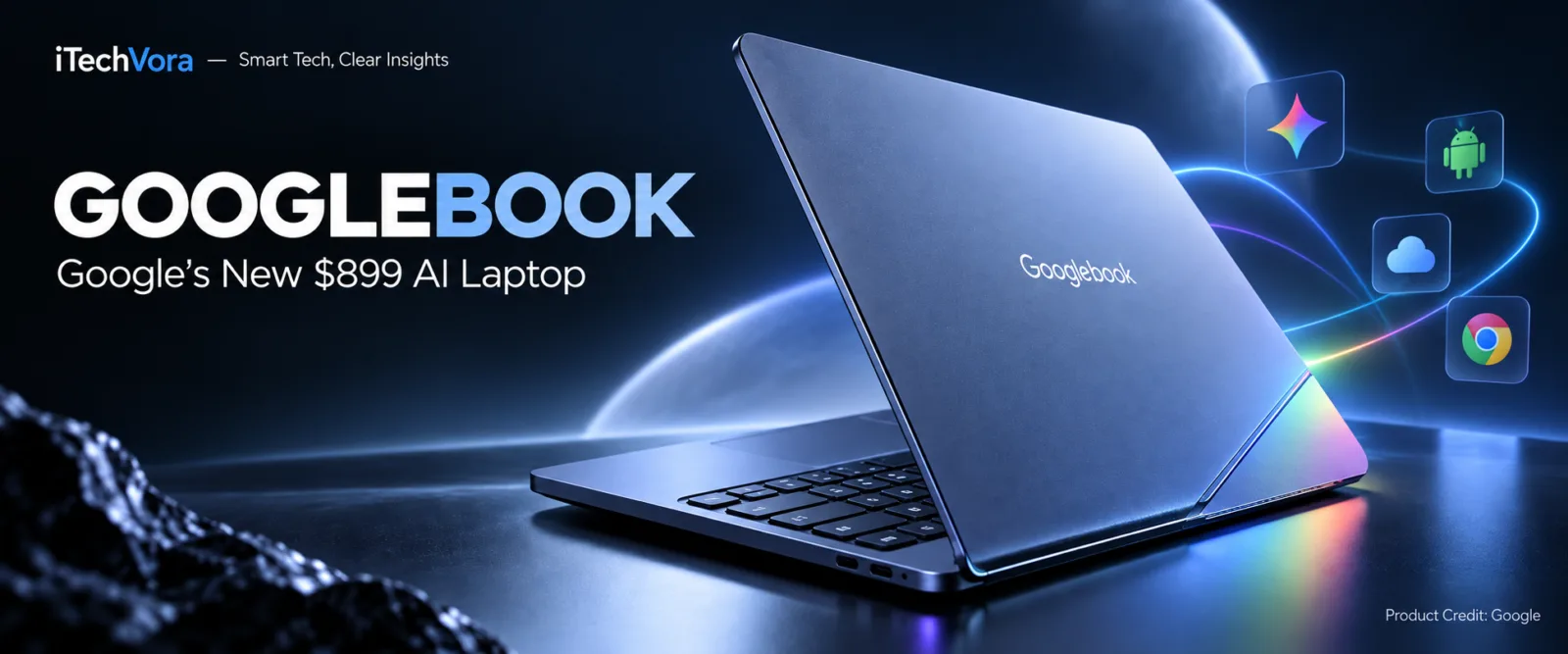
The company has opened pre-orders for Googlebook, a new premium laptop category built around Android technology, familiar ChromeOS desktop foundations and, unsurprisingly, a heavy dose of Gemini AI. Prices start at $899 in the United States, putting these machines well outside the inexpensive Chromebook territory many buyers associate with Google’s laptop ecosystem.
Google isn’t manufacturing one laptop and putting its own logo on the lid. Instead, Acer, ASUS, Dell, HP and Lenovo are launching the first Googlebook models, giving buyers different sizes and form factors while Google controls much of the underlying software experience.
That makes Googlebook more than a Chromebook refresh. It is Google’s attempt to answer a bigger question: can Android finally have a premium laptop ecosystem of its own?
Googlebook Is a Platform, Not Just One Google Laptop
The name can initially be confusing.
Googlebook isn’t a single machine in the way a MacBook Air is one specific Apple product family. Google has created the platform and software experience, while established PC manufacturers are building the hardware.
Five manufacturers are involved at launch:
| Manufacturer | Launch approach |
|---|---|
| Acer | Convertible design that can switch between laptop and tablet use |
| ASUS | Lightweight model aimed at portability |
| Dell | Compact premium laptop |
| HP | Premium conventional laptop design |
| Lenovo | Larger 15-inch-class model focused on productivity |
Google says the range begins at $899, so this clearly isn’t intended to replace the affordable Chromebook sitting in a school classroom or being sold as an inexpensive secondary computer.
That distinction matters.
Chromebooks built much of their reputation around simplicity, long battery life and comparatively low prices. Googlebook is moving in the opposite direction: better materials, stronger processors, higher-resolution displays, more memory and considerably greater emphasis on local AI processing.
Google is effectively creating a premium tier above the traditional Chromebook market.
The Bigger Change Is Underneath the Hardware
The hardware specifications are important, but Googlebook’s software direction is arguably the bigger development.
Google describes the platform as being built on the Android technology stack combined with desktop foundations from ChromeOS. In practical terms, Google is trying to bring its phone and computer ecosystems much closer together rather than simply treating Android apps as something that happens to run on a laptop.
That could be significant.
Android dominates smartphones globally, yet Android phone owners often move into a completely different environment when they sit down at their laptop. A Samsung, Pixel, OnePlus or Motorola phone may end up beside a Windows computer where cross-device integration depends on a combination of Microsoft tools, manufacturer software and individual apps.
Apple’s advantage has traditionally been much easier to explain: use an iPhone and a Mac, sign into the same ecosystem, and many interactions are designed around the assumption that both devices belong together.
Googlebook is clearly trying to create its own version of that relationship.
Google says the new laptops are designed to work closely with Android phones, including carrying tasks between devices and giving users more continuity when moving from a phone to a computer.
The success of Googlebook may therefore depend less on benchmark charts and more on whether this phone-to-laptop relationship genuinely becomes useful enough to change buying habits.
Gemini Isn’t an Extra App Here
Another important difference is the role of AI.
Most modern laptops can already run Gemini, ChatGPT, Copilot and other AI services in a browser or application. Simply putting Gemini on a laptop wouldn’t make Googlebook particularly unusual.
Google is trying to go deeper by integrating Gemini into the way users interact with the operating system itself.
One example is Magic Pointer. Google describes it as a contextual extension of the traditional mouse pointer. The system can understand text, images and what is happening on the screen, then make Gemini assistance available around the content the user is interacting with.
There is also Rambler, an AI-assisted dictation feature intended to take less organized spoken thoughts and turn them into cleaner written text.
Those ideas are more interesting than simply placing an AI button in a taskbar because they attempt to change normal laptop interactions.
Whether people actually want AI woven this deeply into their everyday computer use remains another question.
AI features often look useful in demonstrations but become much less important if accessing them interrupts a user’s normal workflow. Googlebook has an opportunity here because Google controls both Android and much of the software experience surrounding Gemini. The real test will be whether these tools save enough time that users begin relying on them naturally.
The Hardware Is Far Beyond the Cheap Chromebook Formula
Google is also making sure Googlebook doesn’t immediately look or feel like a budget machine.
The company says models can use materials including aluminum, magnesium alloy and carbon fiber, while touch displays can reach 2.8K resolution. Large haptic trackpads, backlit keyboards and premium audio configurations are also part of the platform.
Processor options at launch include Intel Core Ultra Series 3 and Qualcomm Snapdragon X Elite chips.
Google says these processors are paired with NPUs delivering more than 45 TOPS of on-device AI performance.
TOPS—trillions of operations per second—is commonly used to describe the processing capability of an NPU. An NPU is a specialized part of a processor designed for workloads such as local AI inference.
A higher TOPS figure doesn’t automatically make one laptop faster in every task. It primarily tells us about the hardware available for certain AI workloads. CPU performance, graphics capability, memory, cooling and software optimization still matter for everyday computing.
Every Googlebook starts with at least 16GB of RAM, according to Google, while some configurations can reach 32GB.
That baseline is particularly telling. Google isn’t trying to squeeze its new operating environment into entry-level hardware. Sixteen gigabytes puts the machines much closer to mainstream premium Windows laptops and Macs than traditional low-cost Chromebooks.
Battery Life Could Be Another Important Part of the Pitch
Google claims up to 14 hours of video playback and 16 hours of web browsing for the platform, although actual battery life will naturally depend on the specific laptop, processor, display, applications, brightness and workload.
Manufacturer battery claims should always be treated as controlled test figures rather than guaranteed real-world results.
Still, the inclusion of Snapdragon X Elite models makes the battery story worth watching. Arm-based laptop processors have increasingly focused on efficiency, while Google’s Android foundation is already deeply associated with Arm hardware.
At the same time, Intel-powered Googlebooks give buyers another route and may prove useful where software compatibility or particular workflows matter more.
Having both architectures is sensible, but it also creates a responsibility for Google: buyers need to know whether the applications they rely on behave identically across them.
Googlebook Brings Back a Surprisingly Visible Design Detail
One of the more unusual hardware ideas is something Google calls the Glowbar.
It is a lighting element that can animate when the computer starts, display battery-related information and support additional patterns. Google also plans to give developers access to it for custom animations.
Nobody needs a glowing laptop strip to finish a spreadsheet, of course.
But the idea highlights something Googlebook needs if it wants to become a recognizable product category: identity.
Windows laptops come from dozens of manufacturers and can look dramatically different from one another. MacBooks are immediately recognizable because Apple controls the hardware.
Since Googlebook hardware also comes from several companies, Google needs common design or interaction cues that make users recognize a machine as part of the same ecosystem. The Glowbar may be one small attempt to provide that connection.
The $899 Price Changes the Conversation
This is where things become difficult for Google.
At $899 and above, buyers aren’t choosing between a Googlebook and a basic Chromebook.
They’re shopping in territory occupied by MacBooks and a huge range of capable Windows ultrabooks.
Reuters noted that Google’s launch also arrives as Apple is pushing further into lower-priced laptops, increasing competition in a segment where Chromebook manufacturers were historically strongest at the budget end of the market.
Google therefore can’t depend on price alone.
A buyer willing to spend around $900 or more can already find laptops with excellent screens, long battery life, mature desktop software ecosystems and years of established application compatibility.
Googlebook needs another reason to exist.
The strongest candidate is Android integration.
For someone already using an Android phone, Google Photos, Google Drive, Gmail, Chrome, Google Messages and Gemini every day, a laptop built specifically around the same environment could be attractive.
For someone heavily invested in Windows applications or Apple’s ecosystem, the argument becomes more difficult.
That is why Google’s new laptops shouldn’t simply be judged as faster Chromebooks. Their value depends on whether the Android-Google ecosystem itself becomes enough of a reason to choose one computer over another.
Ten Years of Updates Makes Googlebook More Interesting
Google says Googlebook OS devices will receive feature drops and updates for up to 10 years.
For an expensive laptop, that matters.
Software support is increasingly part of the purchasing decision because the useful life of modern computers can extend well beyond three or four years. Strong update commitments can also make premium pricing easier to justify, assuming hardware remains capable over that period.
Google is additionally bundling 12 months of Google AI Pro with Googlebook purchases, along with other promotional subscriptions. Google says the AI Pro package includes 5TB of cloud storage and higher Gemini usage limits.
Those extras add initial value, although buyers should separate temporary subscriptions from the long-term value of the laptop itself. A one-year benefit eventually expires; the computer still needs to justify its price after that.
What About Googlebook Availability in India?
For Indian buyers, there is an important limitation at launch.
Google says the first Googlebooks will reach retail on October 4 in the United States, followed by October 5 in Canada, the United Kingdom, Ireland, France, Germany and Australia. India is not included in Google’s announced initial market list.
That means there is currently no official Indian Googlebook price to compare with Windows laptops or MacBooks sold here.
It would also be misleading to simply convert the $899 US price into rupees and treat that number as expected Indian pricing. Taxes, distribution, configurations and regional pricing strategies can all significantly change the final price.
Indian availability is worth watching, though. Android has a huge presence in the country, which makes the basic idea behind Googlebook especially relevant.
The challenge would be pricing.
Premium Windows laptops already have a strong presence in India, while Apple’s MacBook lineup has become increasingly visible among students, developers and professionals. Googlebook would need both competitive local pricing and clear advantages beyond Gemini branding.
Googlebook’s Real Competition Isn’t Chromebook
The easiest way to misunderstand Googlebook is to see it as an expensive Chromebook.
Google appears to be aiming much higher.
Its real competition is the premium personal-computing ecosystem itself: Windows laptops on one side and Apple’s MacBooks on the other.
The hardware specifications appear capable of putting Googlebook in that conversation. Premium materials, modern Intel and Qualcomm processors, at least 16GB of memory, high-resolution touch displays and dedicated AI processing give the platform the basic ingredients expected at this price.
But specifications aren’t the hardest part.
The harder task is convincing someone that Android belongs on their laptop as much as it belongs on their phone.
If Google succeeds, Googlebook could fill a gap that has existed for years. Android users would finally have a premium computer designed from the beginning to sit inside the same ecosystem as their phone.
If the integration ends up feeling like Android apps placed inside another desktop interface, buyers may struggle to see why they should move away from Windows or macOS.
That’s why Googlebook is interesting even before the first long-term reviews arrive.
The $899 starting price tells us Google isn’t experimenting at the cheap end of the market anymore. Google is asking buyers to consider its platform alongside established premium laptops—and betting that Android integration plus Gemini intelligence can finally give them a reason to do it.
Googlebook lineup — Acer Googlebook 14, ASUS Googlebook 14, XPS Googlebook, HP Googlebook 14, Lenovo Googlebook 15
Googlebook is Google’s new premium laptop platform built around Android integration, Gemini Intelligence, and higher-end hardware. The lineup starts at $899 in the US, with Intel Core Ultra 5 or Snapdragon X Elite processors, 16GB RAM, and model-specific OLED or LCD touch displays.
How we tested
Not tested by iTechVora. This article is based on official Google specifications, launch information, and verified public sources.
What we like
- 16GB RAM is standard across the US launch lineup
- 512GB storage is standard across the US launch lineup
- Choice of Intel Core Ultra 5 and Snapdragon X Elite processors
- Deep Android phone integration
- Gemini Intelligence is built into the platform
- Premium OLED options are available on most launch models
- Up to 10 years of Googlebook OS updates
What to consider
- Starting price is premium compared with traditional Chromebooks
- India is not included in the initial launch-market list
- Processor architecture varies between models
- Display size, panel type, battery life, and weight differ by model
- Manufacturer battery figures are based on controlled tests, not guaranteed real-world use
Key specifications
| Product family | Googlebook |
|---|---|
| Launch partners | Acer, ASUS, Dell, HP, Lenovo |
| Starting price | $899 USD |
| Processors | Intel Core Ultra 5 or Qualcomm Snapdragon X Elite, depending on model |
| Memory | 16GB RAM standard on US launch lineup |
| Storage | 512GB on US launch lineup |
| Display sizes | 13.4-inch to 15.3-inch |
| Display types | OLED touchscreen or LCD touchscreen, depending on model |
| Maximum display resolution | Up to 2.8K |
| NPU performance | Up to 45–49 TOPS, depending on model |
| Battery claim | Up to 13–19 hours of web-browsing battery life, depending on model |
| Weight | 2.2–2.84 lb, depending on model |
| Keyboard | Backlit keyboard |
| Security | Titan C/C2 security hardware; fingerprint reader; face unlock on selected models |
| Operating system | Googlebook OS |
| AI platform | Gemini Intelligence |
| Phone compatibility | Android integration |
| Software support | Up to 10 years of updates |
| Processor | Intel Core Ultra 5 or Qualcomm Snapdragon X Elite, depending on model |
| Graphics | Leave blank unless the CMS allows “Integrated graphics, model-specific; official launch page does not list GPU details.” |
| Memory & storage | 16GB RAM / 512GB storage on the US launch lineup |
| Display | 13.4–15.3-inch touchscreen; 2.5K LCD or up to 2.8K OLED depending on model |
| Battery & weight | Up to 13–19 hours claimed web-browsing battery life; 2.2–2.84 lb depending on model |
Side-by-side comparison
| Feature | Acer Googlebook 14 | XPS Googlebook |
|---|---|---|
| Starting price | $899 | $999 |
| Processor | Intel Core Ultra 5 | Snapdragon X Elite |
| Memory | 16GB | 16GB |
| Storage | 512GB | 512GB |
| Display | 14-inch 2.8K OLED touchscreen | 13.4-inch 2.5K LCD touchscreen |
| Battery claim | Up to 16 hours | Up to 18 hours |
| Weight | 2.51 lb | 2.2 lb |
| NPU | Up to 47 TOPS | Up to 45 TOPS |
Your questions, answered
What is Googlebook?
Googlebook is Google’s new premium laptop category built on Android technology with desktop foundations from ChromeOS and designed around Gemini Intelligence.
How much does Googlebook cost?
The US launch lineup starts at $899 for the Acer Googlebook 14.
Which companies make Googlebook laptops?
Acer, ASUS, Dell, HP, and Lenovo are the initial hardware partners.
What processors do Googlebooks use?
Launch models use Intel Core Ultra 5 or Qualcomm Snapdragon X Elite processors, depending on the model.
How much RAM does a Googlebook have?
The US launch lineup comes with 16GB RAM as standard.
How much storage does a Googlebook have?
The US launch lineup lists 512GB storage across all five initial models.
Is Googlebook available in India?
India is not included in Google’s initial launch-market list as of September 23, 2026.
Does Googlebook work with Android phones?
Yes. Google says Googlebook is designed to work closely with Android phones and support cross-device workflows.
Price & availability
$899.00
Price last checked on 2026-09-23. Check the retailer for the latest price.
Check Googlebook / Google Store ↗No affiliate relationship or sponsorship. Product information and pricing were checked against official Google sources.
Sources & further reading