
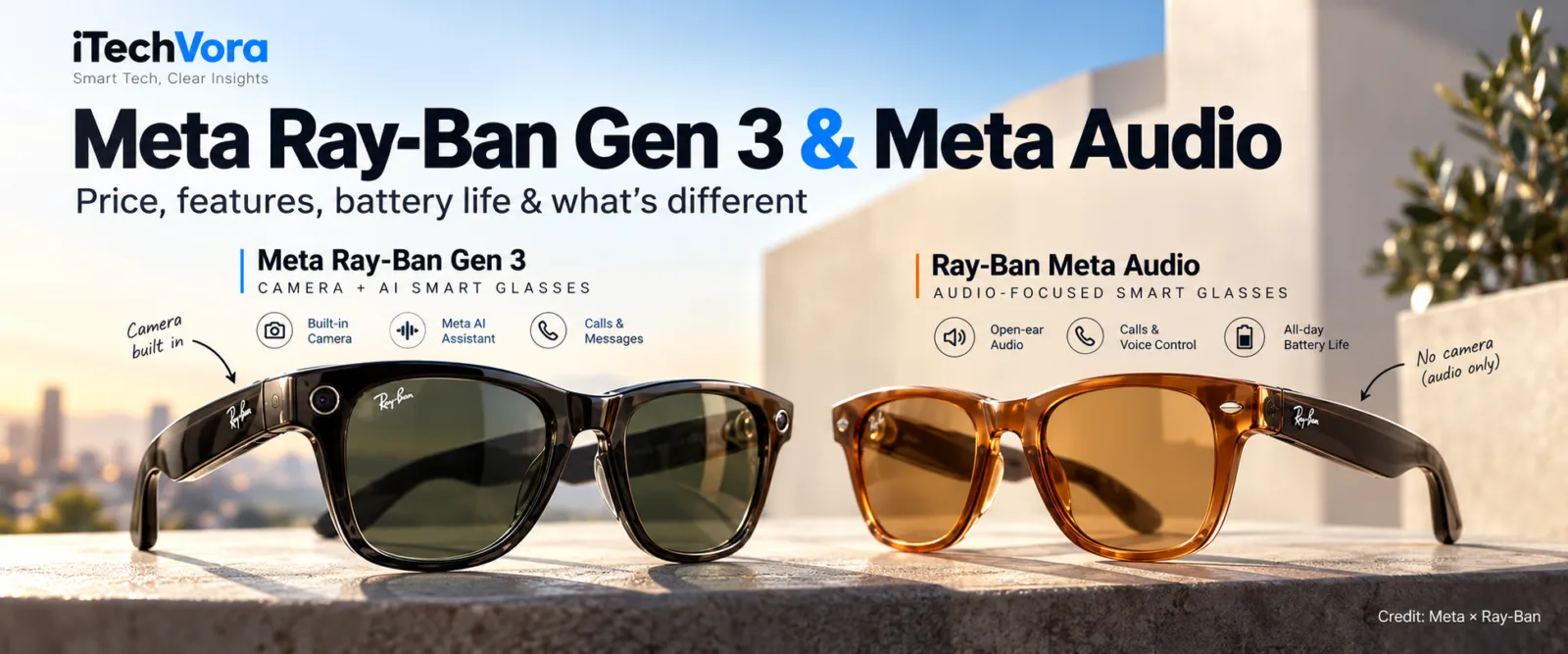
Meta’s latest Ray-Ban glasses are taking two noticeably different paths.
The new Ray-Ban Meta (Gen 3) keeps the camera, hands-free capture and AI features that have defined the product so far, but puts them into a slimmer design with better battery life and updated controls. The new Ray-Ban Meta Audio, meanwhile, removes the camera completely and concentrates on open-ear audio, calls and hands-free AI.
That distinction may end up being more important than any single specification. Someone who wants to record photos and video without pulling out a phone still has Gen 3. Someone who likes the idea of smart glasses but has little interest in wearing a camera on their face now has another option.
Meta announced both products at Meta Connect 2026 on September 23. Ray-Ban Meta Gen 3 starts at $449 in the US, while Ray-Ban Meta Audio starts at $349. Gen 3 is already available in supported markets, while Meta says the Audio model begins shipping on October 13, 2026.
At a Glance
| Detail | Ray-Ban Meta Gen 3 | Ray-Ban Meta Audio |
|---|---|---|
| Product type | Camera + audio AI glasses | Audio-focused AI glasses |
| Starting US price | $449 | $349 |
| Camera | 12MP | None |
| Video | Up to 3K Ultra HD | Not applicable |
| Rated battery | Up to 9 hours | Up to 12 hours |
| Charging case | Included | Included, up to 48 additional hours |
| Microphones | Six-microphone array | Designed for calls and AI interaction |
| Main styles | Wayfarer, Aviator, Zena | Clubmaster, Burbank |
| Availability | Available now in supported markets | Pre-order; shipping October 13 |
| Prescription support | Varies by frame/lens configuration | Supported across a wide range of prescriptions |
Prices and availability can vary by market and lens configuration. Meta’s quoted figures are starting US prices.
Quick Take
The most interesting change is not that Ray-Ban Meta glasses have gained another hour of battery life or another frame design. It is that Meta is no longer asking every smart-glasses buyer to accept a built-in camera.
Ray-Ban Meta Gen 3 remains the more capable option for capturing what you see. Ray-Ban Meta Audio takes a different approach: lighter glasses, longer quoted battery life and no camera.
That creates a much clearer choice between capture-first smart glasses and audio-first smart glasses.
Useful Official Links
Meta’s official Ray-Ban Meta Audio and Gen 3 announcement: Meta announcement
Ray-Ban Meta Audio product listing: Ray-Ban Meta Audio Burbank
Meta Connect 2026 overview: Meta Connect 2026 announcements
Ray-Ban Meta Gen 3 Is More Refinement Than Reinvention
Gen 3 builds on an idea Meta and Ray-Ban have already been developing for several generations: eyewear that still looks relatively conventional while hiding cameras, microphones, speakers and AI access inside the frame.
The headline hardware includes a 12MP camera capable of 3K Ultra HD video recording. That means Gen 3 continues to work as a hands-free camera for situations where reaching for a phone would interrupt the moment.
Meta has also redesigned the glasses around comfort. The company describes the frame as slimmer than before and has added professionally adjustable temple tips.
There are now three primary styles: Wayfarer, Aviator and Zena, with Meta announcing 27 frame-and-lens combinations. A limited-edition Aviator has also been created around the style’s 90th anniversary.
The changes are therefore not limited to electronics. Meta and Ray-Ban continue to treat these as eyewear first, which matters for a device someone may be expected to wear for hours rather than occasionally pick up like a phone or camera.
Battery Life Moves to Nine Hours
Battery life has been one of the easiest limitations to notice with earlier smart glasses.
Ray-Ban Meta Gen 2 was rated for up to eight hours of typical use, with its charging case providing another 48 hours. Gen 3 increases the glasses’ quoted runtime to up to nine hours.
An extra hour is not a dramatic generational jump, especially when Gen 2 had already doubled the four-hour rating of the original model. Still, it moves the glasses slightly closer to lasting through a normal working day without requiring a return to the case.
Actual battery life will naturally depend on what the glasses are doing. Recording video, streaming audio and frequent AI interactions are different workloads, so Meta’s maximum figure should be treated as a rated estimate rather than a guaranteed runtime.
The New Action Button Could Be More Useful Than It Sounds
Gen 3 adds a customizable action button designed to provide faster access to Meta AI.
A dedicated physical control may sound minor beside cameras and AI models, but wearables live or die on how much friction they remove. If interacting with the glasses repeatedly requires pulling out a phone or navigating several steps, some of the appeal disappears.
A configurable button gives Meta another way to make frequent actions available without turning the glasses into a screen-heavy device.
Six Microphones Target a Very Real Smart-Glasses Problem
Meta has moved Gen 3 to a six-microphone array.
The company claims the updated system can reduce more than 90% of background noise during calls and voice interaction. That figure comes from Meta and should not be treated as independent testing, but the direction of the upgrade makes sense.
Smart glasses are often used outside the home, where traffic, wind, conversations and other environmental noise can interfere with voice commands.
Because iTechVora has not tested Gen 3, it would be premature to say how much better the microphones actually sound in difficult environments. What can be confirmed is that improving voice pickup has received more hardware attention in this generation.
Ray-Ban Meta Audio Takes the Camera Out of the Equation
Ray-Ban Meta Audio may be the more interesting addition because it removes one of the most recognizable features of Meta’s smart glasses.
There is no camera.
Instead, the glasses are built around open-ear listening, phone calls and voice interaction with Meta’s AI ecosystem.
That decision immediately changes the product’s character. These are not primarily glasses for recording your surroundings. They are closer to combining traditional eyewear with some of the functions people normally expect from wireless earbuds and a voice assistant.
Meta says the frames weigh just 43 grams, making them its lightest and slimmest AI glasses so far.
For something intended to stay on a person’s face for much of the day, weight may ultimately be more meaningful than adding another headline feature.
Up to 12 Hours of Battery Changes the Practical Equation
Removing the camera appears to give Meta more room to prioritize endurance.
Ray-Ban Meta Audio is rated for up to 12 hours on one charge, with the included case providing as much as 48 additional hours of charging capacity.
That gives Audio a three-hour rated advantage over Gen 3.
Again, those figures are manufacturer ratings and real-world results will depend on audio playback, calls, AI use, connection quality and other factors. But someone mainly interested in music, calls and AI may see more value in longer wear time than in carrying a camera they rarely use.
Clubmaster and Burbank Give Audio Its Own Identity
Meta Audio launches in two Ray-Ban styles: Clubmaster and Burbank.
Across the range, Meta says there are 23 color and lens combinations, including prescription-compatible options. Ray-Ban’s US store currently lists Meta Audio models for pre-order, with prices changing according to frame, lens and prescription configuration.
This is important when looking at the advertised $349 starting price. Smart eyewear is not sold like a phone with one fixed configuration. Prescription lenses, Transitions lenses, polarization and frame choices can move the final purchase price significantly higher.
The same caution applies to Gen 3. Although Meta gives a $449 starting price, Ray-Ban currently lists some US Gen 3 configurations above that level.
Gen 3 vs Meta Audio: The Real Difference
| Area | Ray-Ban Meta Gen 3 | Ray-Ban Meta Audio |
|---|---|---|
| Hands-free photos | Yes | No |
| Hands-free video | Yes | No |
| Open-ear music | Yes | Yes |
| Calls | Yes | Yes |
| AI voice interaction | Yes | Yes |
| Quoted battery | Up to 9 hours | Up to 12 hours |
| Camera privacy consideration | Built-in camera with capture indicator | No camera |
| Best fit conceptually | Users who want capture + AI + audio | Users focused on audio + AI |
This comparison makes the product strategy much easier to understand.
Gen 3 carries more hardware capability. Audio intentionally removes capability in exchange for a simpler product with lower starting pricing, less weight and longer rated battery life.
That is not automatically a downgrade. For some buyers, the missing camera may be the feature that makes the product more appealing.
Camera-Free Glasses May Address an Important Social Barrier
Smart-glasses cameras have always introduced a question that normal headphones do not: how comfortable are the people around the wearer?
Ray-Ban Meta Gen 3 retains an outward-facing LED designed to indicate when the camera is recording. Meta says this is intended to make photo and video capture visible to nearby people.
Meta Audio avoids that issue at the hardware level because it cannot take photos or video.
That does not remove every privacy consideration. The glasses still use microphones, connect to digital services and interact with AI features. Users should still understand account requirements, app permissions and how connected services handle data.
But removing the camera changes one of the most obvious concerns surrounding wearable technology.
Meta Is Also Bringing Muse to Its Glasses
Hardware is only part of Meta’s 2026 glasses strategy.
At Connect, the company announced plans to bring its Muse personal AI agent to AI glasses in the coming months. Meta says users will eventually be able to interact with Muse through the glasses and, on camera-equipped models, let the system respond to objects or information in view.
This is an area where buyers should pay attention to timing.
A feature demonstrated or announced at an event is not necessarily available on every product immediately. Meta has described the glasses integration as coming in the months ahead, so Muse should not be treated as a fully available launch-day Gen 3 feature everywhere.
AI functions can also vary by country and language.
What About Ray-Ban Meta Gen 2?
Gen 2 remains an important reference point because it was launched only a year ago.
It already offered a 12MP camera, 3K Ultra HD recording and up to eight hours of quoted battery life. Gen 3 therefore does not make Gen 2 suddenly obsolete on specifications alone.
The newer model improves endurance, introduces different frames, changes the fit, adds the customizable action button and moves to the updated microphone arrangement.
For an existing Gen 2 owner, those are evolutionary changes rather than an entirely new product concept.
For someone buying smart glasses for the first time, however, the choice has become broader because Meta Audio now provides a significantly different alternative rather than merely another generation.
Price and Availability
As of September 25, 2026, Meta lists Ray-Ban Meta Gen 3 as available with a US starting price of $449.
Ray-Ban Meta Audio starts at $349 in the US, with pre-orders open and shipping scheduled to begin October 13.
Exact prices depend on the frame and lens configuration.
Meta’s global announcement does not provide official India pricing for these new models, so a direct dollar-to-rupee conversion should not be presented as an Indian retail price. Regional availability should be checked through Meta or Ray-Ban before purchasing.
Who Should Pay Attention to Each Model?
The distinction is fairly straightforward without needing to declare one model universally better.
Ray-Ban Meta Gen 3 makes more sense conceptually for people attracted to hands-free photography and video, particularly if capturing a moment without holding a phone is one of the reasons they want smart glasses.
Ray-Ban Meta Audio is aimed at a different behavior: wearing glasses for long periods while listening to audio, handling calls and accessing AI without carrying a camera on the face.
People primarily interested in AI and audio may find the Audio version’s lighter frame, longer claimed battery life and lower starting price more relevant than Gen 3’s camera hardware.
iTechVora Perspective
The most important development in Meta’s latest Ray-Ban lineup is choice.
Earlier generations largely asked buyers whether they wanted camera-equipped smart glasses at all. The 2026 lineup asks a more useful question: what do you actually want smart glasses to do?
Gen 3 develops the existing camera-and-AI formula rather than replacing it. The improvements to battery life, fit, controls and microphones make the hardware more mature, but there is no need to pretend it is a complete reinvention of Gen 2.
Meta Audio is the bigger strategic change.
By stripping out the camera, Meta can offer something lighter, less expensive at the starting level and rated to run longer. It also gives buyers uncomfortable with wearable cameras a route into the company’s glasses ecosystem.
The next question is no longer simply whether smart glasses can work. It is whether enough people see audio, AI and hands-free assistance as useful enough to make smart eyewear part of their normal day.
That question will become easier to answer once the new models have been independently tested outside launch demonstrations.
Frequently Asked Questions
How much do Ray-Ban Meta Gen 3 glasses cost?
Meta lists Ray-Ban Meta Gen 3 from $449 in the United States. The final price can increase depending on frame style, lens type and prescription options.
Do Ray-Ban Meta Audio glasses have a camera?
No. Ray-Ban Meta Audio is intentionally designed without a camera. It focuses on open-ear audio, calls and AI interaction.
What is the battery life of Ray-Ban Meta Gen 3?
Meta rates Gen 3 for up to nine hours on a charge. Actual runtime can vary according to usage.
How long does Ray-Ban Meta Audio last?
Meta quotes up to 12 hours per charge, with as much as another 48 hours available through the charging case.
When will Ray-Ban Meta Audio be released?
Pre-orders opened following the September 23 announcement, with shipping scheduled to begin October 13, 2026. Availability can differ between markets.
Is Ray-Ban Meta Gen 3 a big upgrade over Gen 2?
Gen 3 increases quoted battery life from eight to nine hours and introduces changes to fit, styles, microphones and controls. Both generations support 12MP photography and 3K video, so the jump is more evolutionary than a complete redesign of the core concept.
Trusted Sources Used
The primary research source was Meta’s September 23, 2026 announcement covering Ray-Ban Meta Audio and Ray-Ban Meta Gen 3. Meta Newsroom — Ray-Ban Meta Audio and Gen 3
Current product pricing and Meta Audio pre-order information were cross-checked with Ray-Ban’s official US store. Ray-Ban US
Previous-generation specifications were checked against Meta’s official Gen 2 launch information and Ray-Ban documentation. Meta — Ray-Ban Meta Gen 2 announcement
Meta Connect 2026 information about Muse and the wider glasses ecosystem was verified through Meta’s official Connect coverage. Meta Connect 2026 recap
Ray-Ban Meta (Gen 3) / Ray-Ban Meta Audio
Ray-Ban Meta (Gen 3) is the more capable choice for people who want hands-free photo and video capture alongside open-ear audio and Meta AI, while Ray-Ban Meta Audio removes the camera in favor of a lighter, audio-first design and longer manufacturer-rated battery life. Gen 3 reaches up to 9 hours per charge; Meta Audio is rated for up to 12 hours. Both require a compatible smartphone, Meta account and Meta AI app, and feature availability varies by region and language.
How we tested
Research-based assessment; no iTechVora hands-on wearable testing conducted. Specifications and feature information are based on verified manufacturer documentation and clearly attributed independent sources where applicable.
What we like
- Ray-Ban Meta (Gen 3) combines a 12MP ultra-wide camera with up to 3K Ultra HD video recording.
- Gen 3 increases manufacturer-rated battery life to up to 9 hours, with up to 50 additional hours available from the fully charged case.
- Ray-Ban Meta Audio provides a camera-free alternative for users primarily interested in open-ear audio, calls and Meta AI.
- Meta Audio is rated for up to 12 hours per charge and up to 48 additional hours from its charging case.
- Both ranges use a six-microphone array and open-ear speakers.
- Prescription lens options are available across supported configurations.
What to consider
- A compatible smartphone, Meta account, Meta AI app and wireless internet connection are required.
- Ray-Ban Meta Audio has no camera, so camera-dependent Multimodal AI and Live AI functionality is unavailable.
- Both products carry an IPX4 water-resistance rating; this is intended for situations such as light rain, not immersion.
- Certain Meta AI and voice features are limited by country and language.
- Ray-Ban Meta Audio is currently a pre-order product, with Meta announcing October 13, 2026 as the beginning of shipments.
- The advertised $449 and $349 figures are starting US prices; prescription, Transitions, polarized and other lens configurations can cost more.
Key specifications
| Product | Ray-Ban Meta (Gen 3) / Ray-Ban Meta Audio | ||
|---|---|---|---|
| Manufacturer | Luxottica/EssilorLuxottica; Meta provides the AI and connected technology platform. | ||
| Device type | AI smart glasses | ||
| Models / styles | Gen 3: Wayfarer, Aviator, Zena; Meta Audio: Clubmaster, Burbank. | ||
| Camera | Gen 3: 12MP ultra-wide; Meta Audio: no camera. | ||
| Photo resolution | Gen 3: 3024 × 4032 pixels. | ||
| Video | Gen 3: up to 3K Ultra HD at 30fps; 1080p+ at 30/60fps; 720p+ at 120fps. | ||
| Speakers | Two open-ear speakers. | ||
| Microphones | Six-microphone array on both ranges. | ||
| Controls | Touch and Meta AI voice controls; Gen 3 also includes a dedicated capture control and customizable action button. | ||
| Memory | Gen 3: 32GB flash storage, rated for 1,000+ photos and 100+ 30-second videos; Meta Audio: not applicable because it has no camera. | ||
| Battery life | Gen 3: up to 9 hours; Meta Audio: up to 12 hours, manufacturer-rated. | ||
| Charging case | Gen 3: up to 50 additional hours; Meta Audio: up to 48 additional hours. | ||
| Charging case recharge | Ray-Ban states the cases can fully recharge in about 3.5 hours via USB-C. | ||
| Connectivity | Bluetooth 5.3 and Wi-Fi 6. | ||
| Water resistance | IPX4. | ||
| Display | Not applicable; these models do not include an in-lens visual display. | ||
| Companion app | Meta AI app. | ||
| Account requirement | Meta account required. | ||
| Prescription support | Available on supported configurations. | ||
| Subscription requirement | No subscription requirement verified for core glasses functionality; third-party media services may have their own account or subscription requirements. | ||
| Warranty | One year from purchase in the US; two years for purchases within the EU/EFTA under Ray-Ban's stated limited-warranty terms. | ||
| Device type | AI smart glasses — Ray-Ban Meta (Gen 3): camera + open-ear audio; Ray-Ban Meta Audio: camera-free open-ear audio. | ||
| Display | Not applicable — neither Ray-Ban Meta (Gen 3) nor Ray-Ban Meta Audio includes an in-lens visual display. | ||
| Phone compatibility | Ray-Ban Meta Audio | Current US product listings state iOS 17 / Android 10 minimum, with the Meta AI app, Meta account and wireless internet required. Ray-Ban Meta (Gen 3) | Ray-Ban's current US listings are not fully consistent: the Aviator page and product comparison list iOS 17+ / Android 10+ minimum, while one current Wayfarer listing reports iOS 18.6 / Android 15 minimum. Buyers should check Ray-Ban's supported-phone list for their exact configuration before purchase. |
| Sensors | Ray-Ban Meta (Gen 3) | 12MP ultra-wide camera and six-microphone array; no health or fitness sensor suite is listed in Ray-Ban's official specifications. Ray-Ban Meta Audio | Six-microphone array; no camera and no health or fitness sensor suite listed. |
| GPS | No built-in GPS/GNSS is listed in the official specifications for either model. | ||
| Battery life | Ray-Ban Meta (Gen 3) | Up to 9 hours on one charge plus up to 50 additional hours from the fully charged case; manufacturer-rated and dependent on usage, settings, temperature, connectivity and other factors. Ray-Ban Meta Audio | Up to 12 hours on one charge plus up to 48 additional hours from the fully charged case; manufacturer-rated and dependent on usage, settings, temperature, connectivity and other factors. |
| Water resistance | IPX4 for both products. Ray-Ban states this rating can handle situations such as light rain; it should not be interpreted as waterproof or suitable for immersion. | ||
| Connectivity | Ray-Ban Meta (Gen 3) | Bluetooth 5.3, Wi-Fi 6, compatible smartphone connection through the Meta AI app. Ray-Ban Meta Audio | Bluetooth 5.3, Wi-Fi 6, compatible smartphone connection through the Meta AI app. |
Side-by-side comparison
| Feature | Ray-Ban Meta (Gen 3) | Ray-Ban Meta Audio | Ray-Ban Meta (Gen 2) |
|---|---|---|---|
| Starting US price | $449 | $349 | $379 |
| Device type | Camera + audio AI glasses | Audio-only AI glasses | Camera + audio AI glasses |
| Camera | 12MP ultra-wide | None | 12MP ultra-wide |
| Maximum video | 3K Ultra HD at 30fps | Not applicable | 3K Ultra HD at 30fps |
| Microphones | 6-mic array | 6-mic array | 5-mic array on standard Gen 2 models |
| Rated battery | Up to 9 hours | Up to 12 hours | Up to 8 hours |
| Charging-case capacity | Up to 50 additional hours | Up to 48 additional hours | Up to 48 additional hours |
| Storage | 32GB | Not applicable | 32GB |
| Bluetooth | Bluetooth 5.3 | Bluetooth 5.3 | Bluetooth 5.3 |
| Wi-Fi | Wi-Fi 6 | Wi-Fi 6 | Wi-Fi 6 |
| Water resistance | IPX4 | IPX4 | IPX4 |
| Multimodal camera-based AI | Supported where available | Not available because there is no camera | Supported where available |
Our shortlist
| Not applicable — no iTechVora comparative best-list assessment has been established from hands-on or sufficiently broad comparative testing. |
|---|
Step by step
- Install the Meta AI app on a compatible smartphone.
- Sign in with or create the Meta account that will be used with the glasses.
- Charge the glasses using the supplied charging case before initial setup.
- Turn the glasses on and place them inside the charging case.
- Press and hold the pairing button on the rear of the case for at least five seconds until the case LED pulses blue.
- Open the Meta AI app, add the glasses and follow the on-screen setup instructions.
Your questions, answered
Does Ray-Ban Meta (Gen 3) have a camera?
Yes. It has a 12MP ultra-wide camera capable of recording up to 3K Ultra HD video at 30fps.
Does Ray-Ban Meta Audio have a camera?
No. Meta Audio is designed as an audio-only model without a camera.
How long does Ray-Ban Meta Gen 3 last?
Meta rates it for up to 9 hours per charge, with up to 50 additional hours available through the fully charged case. Actual runtime varies with use.
How long does Ray-Ban Meta Audio last?
Meta rates it for up to 12 hours per charge, with up to 48 additional hours available through the charging case. Actual runtime varies with use.
Can Ray-Ban Meta Audio take photos or videos?
No. It does not include a camera or onboard capture storage.
Does Ray-Ban Meta Audio support camera-based Multimodal AI?
No. Camera-dependent Multimodal AI and Live AI features are not available because Meta Audio does not include a camera.
Are the glasses waterproof?
No. They carry an IPX4 water-resistance rating, which is intended for situations such as light rain rather than immersion.
Do the glasses require a phone?
Yes. A compatible Android or iOS smartphone, Meta AI app, Meta account and wireless internet connection are required.
When does Ray-Ban Meta Audio ship?
Shipments are scheduled to begin on October 13, 2026.
Are prescription lenses supported?
Yes. Prescription configurations are available for supported Ray-Ban Meta Gen 3 and Meta Audio frames.
Price & availability
$449.00
Price last checked on 2026-09-25. Check the retailer for the latest price.
No affiliate or sponsorship relationship confirmed.
Sources & further reading